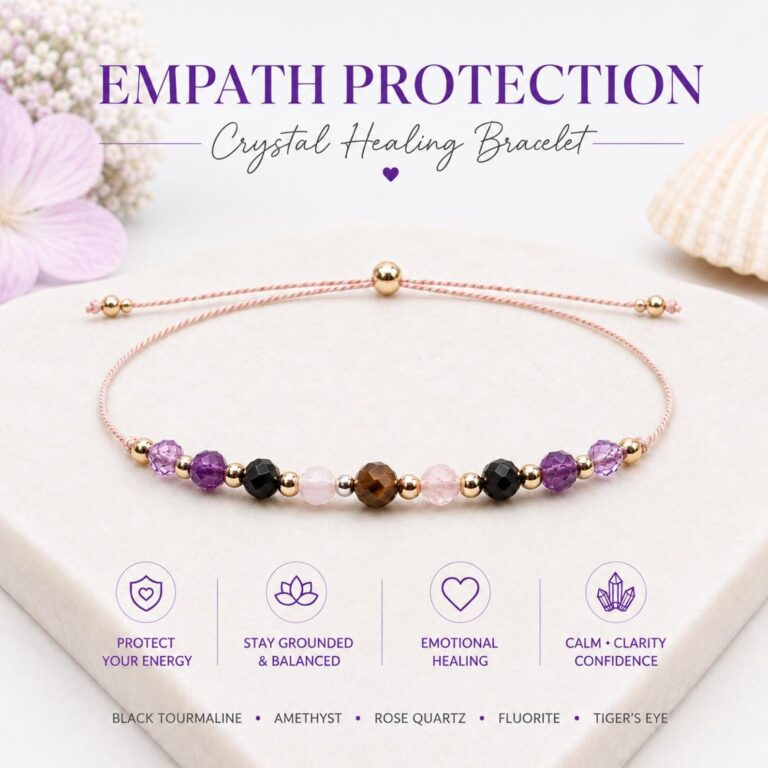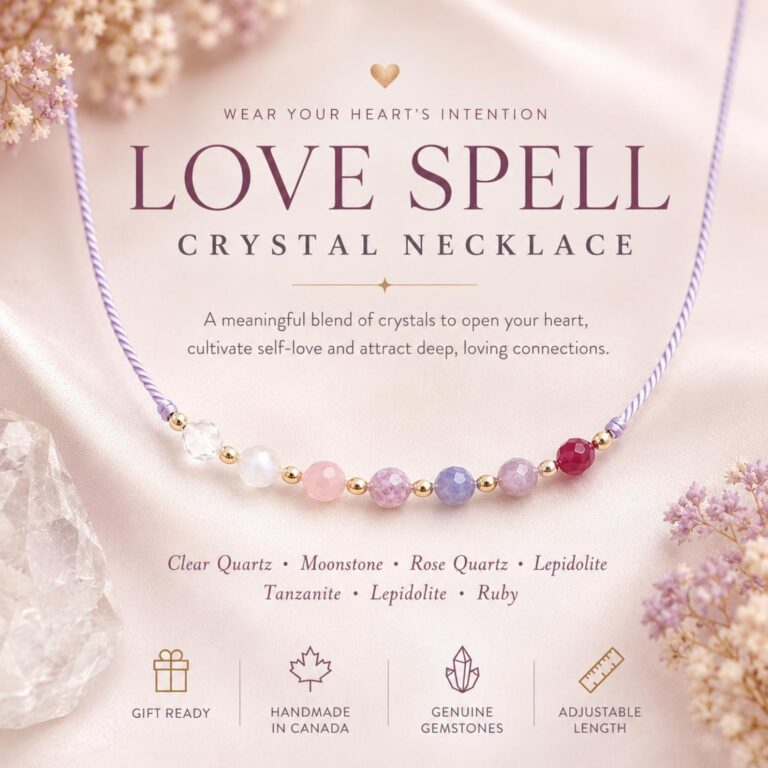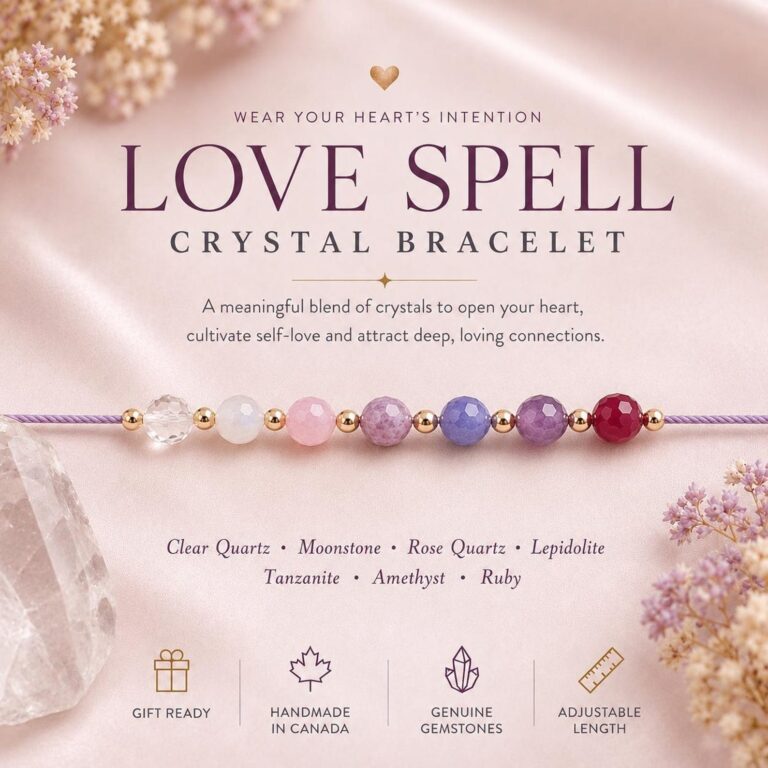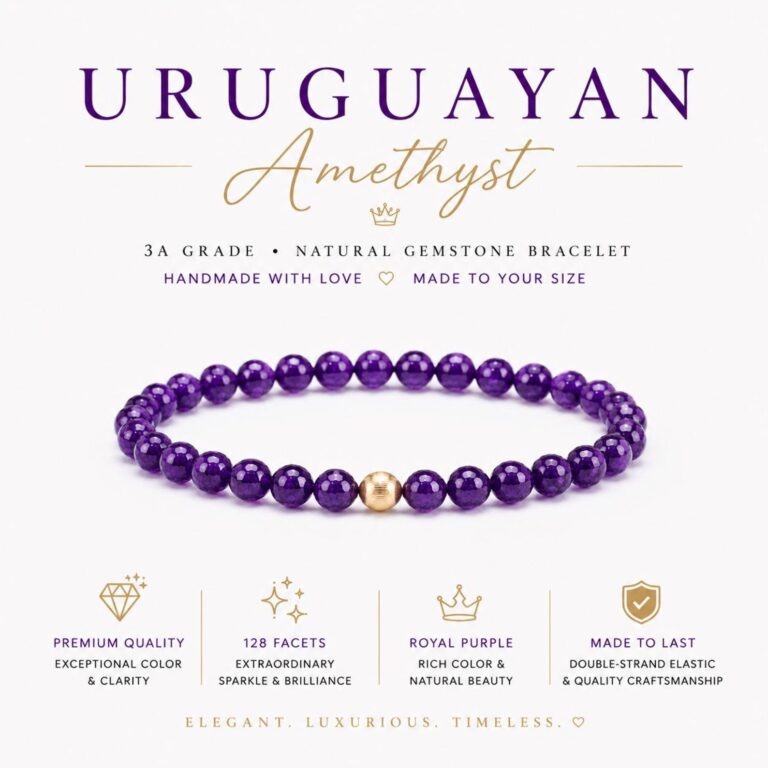
AAA Amethyst Bracelet 6mm Faceted Gemstones – 18k Gold Filled Sterling Silver Accents
$149.95 CAD
Made To Order
Click to View

Amethyst is the violet-to-purple variety of quartz: a genuine gemstone with a long history, a welcoming price range, and enough character to feel anything but ordinary. From pale lilac to richly saturated royal purple, every stone brings its own balance of colour, clarity, cut, and personality. Explore what makes amethyst jewellery so beloved, how to choose a quality piece, and why this February birthstone remains a favourite for meaningful everyday gifts.
Amethyst is a purple variety of crystalline quartz, a mineral composed of silicon dioxide. Quartz is one of the world’s most familiar gem minerals, but amethyst has a special place within it: its colour can range from barely-there lavender through violet, grape, plum, and deep purple with flashes of red or blue.
The purple colour is associated with trace amounts of iron within the quartz crystal structure, together with natural irradiation over geological time. The exact conditions under which a crystal formed influence its depth and distribution of colour. That is why natural amethyst is not simply “purple quartz”; it is a record of remarkable geology, written in colour.
Amethyst has the rare ability to feel both expressive and easy to wear. A soft lavender stone can read as delicate and romantic; a saturated violet amethyst can feel dramatic, regal, and wonderfully confident. It pairs naturally with warm or cool metal tones and can be the focal point of a design or a beautifully colourful detail among other gemstones.
It is also a practical choice. With a hardness of 7 on the Mohs scale, amethyst is suitable for many types of jewellery, including earrings, pendants, bracelets, and thoughtfully worn rings. It is hard enough for regular enjoyment, while still deserving the same mindful care you would give any genuine gemstone.
For gift-giving, genuine amethyst jewellery offers meaning without requiring a grand occasion. It is the traditional February birthstone, a thoughtful anniversary gift, and a lovely choice for anyone drawn to purple, violet, or the quieter beauty of natural variation.
Colour is the feature most people notice first, and it is one of the most important factors in amethyst’s beauty and value. There is no single “best” purple for every wearer. The most appealing stone is often the one whose colour feels alive to you in normal light, not merely under a bright display lamp.
Historically, richly coloured material with red and blue flashes has been especially prized. In contemporary jewellery, however, pale lilac and rose-violet amethyst are equally worth celebrating when the cut, design, and overall look are beautifully balanced.
Natural amethyst can show uneven colour distribution, known as colour zoning. You may see lighter and darker areas, angular bands, or shifts from violet to lavender within one stone. A skilled cut can place and orient that colour to make the gem look its best. Subtle zoning is not automatically a flaw; it is often an honest, fascinating sign of the conditions in which the crystal grew.
Many faceted amethysts used in jewellery appear eye-clean, meaning inclusions are not readily visible without magnification. Yet natural gemstones are not manufactured to be identical. Tiny internal features, fine veils, or growth marks can occur and may help make each stone distinct. Clarity should be considered alongside colour, cutting, size, and the effect of the finished piece—not as an isolated scorecard.
Amethyst occurs in several parts of the world. Brazil and Uruguay are particularly well known for producing amethyst from volcanic geodes, where crystals formed in cavities in ancient rock. Brazil is a major source of material across a wide range of sizes and colours, while Uruguay is often associated with richly coloured crystal-lined geodes. Zambia is another important source and is known for producing attractive, often strongly coloured amethyst. Deposits are also found in countries including South Korea, Madagascar, Russia, India, and Canada.
A gem’s country of origin can be interesting, but origin alone does not determine whether an amethyst is beautiful. Colour, cut, transparency, condition, and the quality of the finished jewellery remain the things a wearer sees and enjoys every day. Unless a specific piece is accompanied by documented origin information, it is best not to assume where its stone was mined.
Amethyst has been treasured for thousands of years. Its name comes from the Greek word amethystos, traditionally interpreted as “not intoxicated.” In ancient Greek and Roman culture, amethyst was associated with sobriety and clear-mindedness, and it appeared in carved objects, jewellery, and drinking vessels. These are cultural beliefs and historical traditions, not scientific properties of the stone.
For centuries, purple dyes and purple gemstones were difficult to obtain, so the colour became closely linked with wealth, rank, ceremony, and royalty. Amethyst was once considered among the most precious gemstones in Europe. The discovery of large deposits in South America made it more widely available, but it did not make it less beautiful. Instead, it allowed more people to wear a gem that had long carried an air of splendour.
Today, amethyst remains February’s birthstone and is often chosen to mark a birthday, an anniversary, a new chapter, or simply a love of colour. Its history is grand; its appeal is wonderfully personal.
Across many cultures and modern crystal traditions, amethyst has been associated with calm, balance, protection, intuition, wisdom, and clear thinking. Its violet colour has also inspired connections with spirituality and contemplation. These meanings can make amethyst jewellery a thoughtful personal talisman or gift.
They are symbolic and cultural associations, however, not established medical or scientific claims. Gemstones should never be presented as a substitute for professional medical, mental-health, or financial advice. The real-world pleasure of amethyst may be simpler and just as worthwhile: a beautiful object can be a welcome reminder of an intention, a person, or a moment that matters.
Amethyst is commonly available in its natural purple colour, and many amethysts are not treated. Heat treatment is also used in the quartz trade and should be understood by shoppers because heating can significantly change quartz colours. For example, some heated amethyst may become yellow to orange and be sold as citrine, or turn greenish in certain circumstances and be marketed as prasiolite. Heating can also lighten or alter the colour of amethyst itself.
Natural and treated gemstones can both be used in jewellery, but clear and accurate disclosure matters. A stone’s treatment status cannot always be determined by appearance alone; this may require gemological testing. Specific treatment information should only be stated for an individual piece when it is known. Likewise, do not assume that a purple quartz gemstone is untreated, or that every golden quartz sold as citrine formed naturally in that colour.
Natural amethyst formed in the earth. Synthetic amethyst is genuine quartz made by people in a controlled laboratory environment; it has essentially the same chemical composition and crystal structure as natural quartz, but a different origin. Imitations are materials used to resemble amethyst without being amethyst, such as coloured glass or other purple-coloured substances.
These categories are not interchangeable. When shopping for genuine amethyst jewellery, it is reasonable to look for clear material descriptions and to ask questions if an important detail is not stated. At Divine by Design Jewelry, genuine gemstones and quality craftsmanship are central to the collection; individual stone characteristics naturally vary.
A memorable amethyst piece is about more than the deepest possible purple. Use these practical points to choose with confidence.
Yes, amethyst jewellery can be enjoyed regularly, particularly earrings and necklaces. At 7 on the Mohs scale, it is harder than many popular jewellery stones. Still, “hard” does not mean indestructible. Quartz can scratch from contact with harder materials, including diamond, sapphire, ruby, and some dust or grit. It can also chip if struck sharply against a hard surface.
Amethyst does not have cleavage, a directional weakness that causes some gems to split along planes, which is a helpful durability trait. Even so, a ring is exposed to more knocks, friction, cleaning products, and hard surfaces than most jewellery. Remove an amethyst ring for gardening, heavy lifting, sports, hands-on work, and activities where it could take a direct impact.
Gentle, routine care will help keep amethyst looking clear and luminous.
For a treasured piece, a professional jeweller can inspect the setting periodically and advise on appropriate cleaning. A secure setting matters just as much as a sparkling stone.
Handcrafted gemstone jewellery should feel personal from the first glance to the hundredth wear. Amethyst brings a remarkable range of colour to that experience, from quiet lavender to rich, expressive purple. Because genuine gemstones vary naturally, no two stones tell exactly the same colour story—and that individuality is part of the charm.
Whether you are celebrating a February birthday, honouring an anniversary, choosing a meaningful gift, or adding a little purple to an ordinary Tuesday, amethyst offers beauty with history, durability with character, and symbolism you can make your own. It is a gemstone that has graced royal collections and ancient stories, yet still knows how to make a simple everyday outfit feel rather more interesting.
Yes. Amethyst is a genuine gemstone and the purple variety of natural quartz. Its colour is linked to iron-related colour centres in the crystal structure and natural irradiation during geological formation.
Yes. Amethyst has a Mohs hardness of 7 and is well suited to earrings, pendants, necklaces, and many bracelets and rings. It should still be protected from hard knocks, scratching, harsh chemicals, and excessive heat or prolonged strong sunlight.
Amethyst is the traditional birthstone for February. Its violet colour and long history make it a popular choice for birthday gifts and jewellery with personal meaning.
Amethysts with attractive, vivid purple colour and good transparency are generally more sought after. Traditionally, medium-dark to dark violet-purple with pleasing red and blue flashes has been highly prized. Value depends on the complete stone—including colour, cut, clarity, size, condition, and market demand—rather than one colour label alone.
No. An amethyst that is too dark can appear inky or lose brightness, especially in lower light. A lighter lavender amethyst can be beautiful, elegant, and entirely intentional. The best choice is a stone with colour you love and enough light return to look lively when worn.
It can. Many jewellery-quality amethysts appear eye-clean, but natural stones may contain small internal features or areas of colour zoning. These characteristics can be part of a gemstone’s natural identity. Very obvious fractures, chips, or inclusions that greatly affect durability are different matters and should be assessed in the context of the individual piece.
Some amethyst may fade or shift in colour after prolonged exposure to strong sunlight or excessive heat. Store amethyst jewellery away from sunny windowsills and avoid leaving it in hot environments, such as a vehicle on a bright day.
It is best to remove amethyst jewellery before showering or swimming. Soap residue can dull its appearance, while chlorine, salt water, and other chemicals may affect metal components or the overall condition of the piece over time.
Ultrasonic cleaning is not the safest blanket recommendation for every amethyst jewellery piece. A sound, untreated stone may tolerate it, but treatments, inclusions, fractures, setting style, and construction can change the answer. Mild soap, lukewarm water, and a soft brush are the safer default when those details are unknown.
Yes. Synthetic amethyst exists and is laboratory-grown quartz with the same basic composition and crystal structure as natural quartz. It should be disclosed as synthetic. This differs from natural amethyst, which formed in the earth, and from imitations such as purple glass.
Many amethysts are sold in their natural purple colour, but heat treatment is used within the quartz gem trade and can alter quartz colour. Treatment status for a specific stone should not be assumed unless it is known and disclosed.
In historical and modern spiritual traditions, amethyst has been associated with sobriety, calm, clarity, protection, wisdom, and spiritual awareness. These are cultural and symbolic meanings, not scientifically established health benefits.
Amethyst is commonly associated with the 6th and 17th wedding anniversaries. Anniversary gift traditions can vary by country and source, so the most meaningful association is the one that suits the people celebrating.
Explore Divine by Design jewelry featuring Amethyst Gemstones & Jewelry Guide.
$149.95 CAD
Made To Order
Click to View