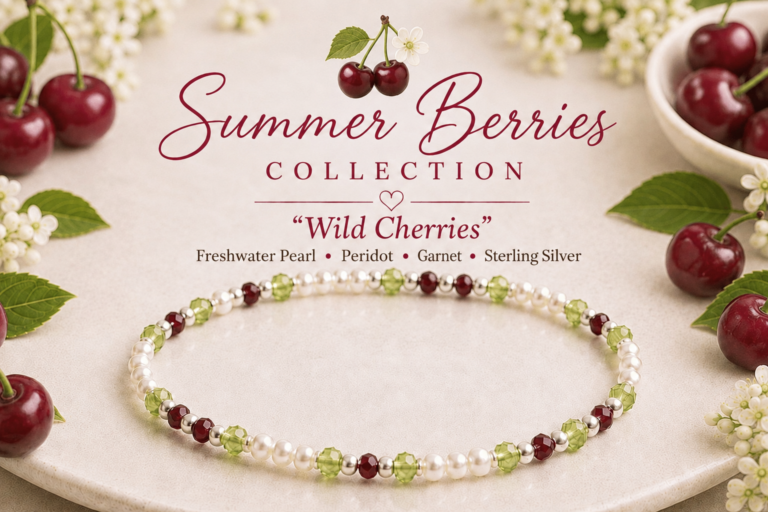
Wild Cherries – Dainty Pearl Bracelet Accented with Garnets & Peridots
$149.95 CAD
Low Stock
Click to View
Rich, glowing and far more colourful than many people realize, garnet is one of the most fascinating gemstone families in the world. Most of us first picture a deep wine-red stone, but garnets can also be vivid green, fiery orange, warm cinnamon, raspberry pink, purple and even exceptionally rare blue-green colour-changing gems. Their diversity is part of what makes garnet such an endlessly interesting gemstone for jewelry lovers.
Garnet also has an unusually long human history. Garnet jewelry has been worn for thousands of years, appearing in ancient ornaments, signet rings, decorative objects and treasured personal jewelry. Today, garnet is best known as the traditional January birthstone, but its beautiful colours, durability and remarkable variety make it worth discovering at any time of year.
Garnet is not a single mineral. It is a group of closely related silicate minerals that share a similar crystal structure but differ in chemical composition. This mineral family includes several species that produce gem-quality material, most notably almandine, pyrope, spessartine, grossular and andradite. Many natural garnets are mixtures of more than one garnet species rather than chemically pure examples of a single member.
That chemistry explains garnet’s extraordinary range of colours. Different elements within the crystal structure influence which wavelengths of light are absorbed and which reach our eyes. The result is a gemstone family capable of producing everything from familiar burgundy red to some of the brightest greens and oranges found in nature.
No—and this is probably the biggest surprise for anyone beginning to explore garnet. Red garnets are abundant and historically important, but the garnet family occurs in an extraordinary palette. Depending on species and composition, natural garnet may be red, burgundy, orange, yellow, green, pink, purple, brown or nearly black. Rare garnets can even display dramatic colour change under different lighting.
Blue is the great exception historically associated with garnet. For many years garnet was commonly described as occurring in every colour except blue, but rare colour-change garnets with blue or blue-green appearances have since been documented. These unusual stones are very different from the familiar red garnet most people encounter in jewelry.
The familiar red colour of many garnets results from their chemical composition and the way particular elements interact with light. Iron plays an important role in the colour of many red garnets, while chromium and other elements can influence colour in different members of the garnet family.
Because garnet is a group rather than a single gemstone species, there is no one formula responsible for every garnet colour. That is one reason learning about garnet can become wonderfully addictive: once you move beyond “the red January birthstone,” an entire family of very different gemstones appears.
Almandine is one of the most familiar garnets and commonly appears in deep red, reddish-brown and wine-red shades. It has been used in jewelry for centuries and is widely available in both faceted gemstones and beads. Fine material can display a beautiful rich red that becomes especially lively when light passes through it.
Pyrope is another important red garnet. Its name comes from words associated with fire, an appropriate description for its often intense red colour. Natural garnets frequently contain mixtures of pyrope and almandine components, so the boundary between varieties is not always obvious simply by looking at a stone.
Rhodolite is a popular trade or variety name generally applied to attractive purplish-red to raspberry-coloured garnets in the pyrope-almandine series. Compared with many traditional dark red garnets, rhodolite can have a brighter, more romantic appearance, sometimes moving toward pink, berry or violet tones.
Spessartine is famous for orange to reddish-orange colours. Exceptionally vivid orange material is sometimes marketed as mandarin garnet. Fine examples can look almost illuminated from within, making spessartine one of the most cheerful and immediately recognizable members of the garnet family.
Grossular demonstrates just how misleading the phrase “garnet red” can be. Grossular garnets occur in several colours, including green, yellow and warm orange-brown. Varieties associated with grossular include tsavorite and hessonite.
Tsavorite is a vivid green grossular garnet coloured primarily by trace elements such as vanadium and chromium. Fine tsavorite can rival emerald in the intensity of its green while offering a different combination of optical and physical properties. It was introduced to the international gem market in the twentieth century and has become one of the most desirable green gemstones.
Hessonite is a grossular garnet typically displaying warm yellow-orange, orange-brown, reddish-orange or cinnamon-like colours. Its distinctive warmth gives it a very different personality from either red almandine or green tsavorite.
Andradite is another garnet species, and its most famous gem variety is demantoid. Fine demantoid is green and can display extraordinary brilliance and fire. Certain historic demantoid garnets are also known for characteristic fibrous inclusions traditionally described as horsetails. Fine demantoid is among the most prized members of the garnet family.
Garnets occur in many parts of the world because the minerals form under a range of geological conditions. Gem-quality garnets have been mined in countries including India, Sri Lanka, Tanzania, Kenya, Mozambique, Madagascar, Namibia and the United States, among many others. Different deposits may become known for particular species, colours or qualities.
East Africa has become especially important for several spectacular garnet varieties, including tsavorite and fine red, orange and colour-change material. As with most gemstones, however, geographic origin should not be treated as a shortcut for quality. An individual garnet’s colour, clarity, cut, size and overall beauty are usually more useful to a jewelry buyer than the prestige of a place name.
Garnets commonly form under conditions of significant heat and pressure and are particularly associated with metamorphic rocks, although members of the garnet group can occur in several geological environments. Because garnet minerals respond to changing temperature and pressure, geologists can also study them for clues about the conditions under which rocks formed and changed deep within Earth.
That makes garnet interesting far beyond the jewelry counter. A polished bead or faceted gem can be the visible result of immense geological processes that occurred long before humans existed. The beauty is immediate; the history locked inside the mineral is almost unimaginably old.
Garnet has one of the longest histories of any gemstone used for personal adornment. Garnet jewelry and carved stones are known from ancient civilizations, and the gemstone remained popular through Roman times and into later European jewelry traditions. Its rich colour made red garnet particularly well suited to settings in gold and other decorative metals.
Garnets were also used for engraved gems and signet-style pieces because suitable material could be polished and carved. Over centuries, garnet accumulated layers of symbolism involving protection, friendship, constancy and safe travel. As with all historical gemstone lore, those meanings reflect human culture rather than scientifically demonstrated powers, but they add fascinating context to a stone people have treasured for millennia.
Garnet became especially important in historic Bohemian jewelry, associated with the region now largely within the Czech Republic. Deep red garnets were set in clusters and elaborate patterns, often producing a rich carpet of glowing red stones. Antique and vintage Bohemian garnet jewelry remains collectible today.
The popularity of this style also helped cement the public image of garnet as a dark red gemstone. Beautiful as those traditional garnets are, modern gemology and global gemstone markets have revealed just how much broader the garnet palette really is.
Garnet value varies enormously because “garnet” covers such a broad family of gemstones. Common commercial red garnet can be quite affordable, while fine tsavorite, demantoid, exceptional spessartine and rare colour-change garnets can be considerably more valuable. There is therefore no meaningful single price for garnet as a category.
Important quality factors include colour, clarity, cut, size, species or variety, rarity and overall beauty. For many coloured gemstones, colour has a particularly strong influence. A lively, saturated garnet with an attractive tone will generally be more desirable than a stone that is so dark its colour becomes difficult to see.
Colour preferences depend partly on the garnet variety. A rich transparent red may be ideal in one garnet, while brilliant green defines fine tsavorite and demantoid, and vivid orange is prized in spessartine. Buyers should resist assuming that darker always means better. In red garnet especially, excessive darkness can hide the very colour that makes the stone beautiful.
Many red garnets can be relatively clean to the eye, while inclusion expectations differ among garnet varieties. Certain inclusions may even be characteristic or appreciated in particular stones. As with other natural gemstones, the important question is whether inclusions interfere significantly with beauty or durability.
A thoughtful cut can bring life to garnet, particularly darker red material. Good proportions allow light to enter and return through the stone rather than disappearing into a dark centre. Garnet is cut into rounds, ovals, cushions, pears and many other shapes, and it is also widely fashioned into polished and faceted beads.
Size affects value differently depending on the garnet variety. Large examples of some common garnets are available, while larger fine examples of rarer varieties may be much harder to find. A small exceptional tsavorite or demantoid may therefore be far more valuable than a much larger ordinary red garnet.
Yes. Garnets can contain a wide range of natural inclusions, and gemologists sometimes use these features to help identify garnet species or understand a stone’s geological history. Inclusions may include crystals, needles, fingerprints or other internal features depending on the type of garnet and how it formed.
In handmade gemstone jewelry, slight differences in transparency, colour and internal character are normal. Beads cut from natural material are not expected to behave like identical manufactured glass beads. Those variations can create depth and personality across a strand and are often part of what makes natural gemstone jewelry appealing.
One appealing characteristic of many garnets is that they are commonly available without the extensive routine treatments associated with some other coloured gemstones. That does not mean every garnet in the marketplace can automatically be assumed untreated, and responsible descriptions should avoid unsupported absolute claims.
Treatment questions become particularly important when a stone is valuable enough for treatment status to affect price materially. For exceptional loose gems, an independent gemological laboratory can provide information that cannot responsibly be established from appearance alone. For small gemstone beads, sellers generally rely on the disclosures and specifications provided by reputable suppliers.
Materials can be manufactured or selected to imitate garnet’s appearance, so colour alone cannot prove that a red stone is natural garnet. Glass, synthetic materials and other gemstones may resemble particular garnets. Gemologists identify stones through their physical and optical properties rather than relying solely on appearance.
The word “garnet” should therefore describe the actual gemstone material, not simply a colour. When buying jewelry, look for descriptions that clearly identify the materials being used and be cautious of extravagant claims unsupported by appropriate documentation.
Ideally, “genuine garnet” should mean that the material is actually garnet rather than glass or another imitation. But the phrase alone does not identify which garnet species or variety is present, its quality, whether a trade name is being used accurately, or whether any treatment has been disclosed.
For ordinary gemstone-bead jewelry, individual laboratory reports are rarely practical because testing every small bead could cost far more than the finished piece. A responsible jewelry maker relies on reputable gemstone suppliers, accurately represents the information available, and avoids claiming specific origin or treatment status without evidence.
Garnet hardness varies across the mineral group but generally falls around 6.5 to 7.5 on the Mohs scale. That makes garnet suitable for many types of jewelry, although it is not as scratch resistant as sapphire or diamond. Different garnet species have somewhat different physical characteristics, so “garnet” cannot be assigned one perfectly universal durability profile.
Garnet necklaces and earrings can be excellent choices for frequent wear, while rings and bracelets naturally encounter more impact and abrasion. In beaded jewelry, remember that the gemstone is only one part of the design. Elastic, cord, pearls, clasps and metal findings may require gentler treatment than the garnet itself.
Many garnet pieces can be worn regularly with sensible care. Avoid striking the stones against hard surfaces and remove jewelry before activities that expose it to unnecessary chemicals, moisture, abrasion or physical strain. Bracelets deserve particular attention because wrists routinely bump against desks, counters and doorways.
For stretch bracelets, gently rolling the bracelet over the hand rather than pulling it widely apart reduces stress on the elastic. Removing jewelry before bathing, swimming, sleeping, strenuous exercise and household cleaning can also help extend the life of the entire piece.
For many garnet pieces, gentle cleaning with lukewarm water, mild soap and a soft cloth or very soft brush is appropriate. Rinse carefully and dry thoroughly. Avoid abrasive cleaners, harsh household chemicals and sudden temperature changes.
Always clean according to the most delicate component in the finished piece. Garnet paired with freshwater pearls, for example, should be treated with the needs of the pearls in mind. Likewise, elastic or silk-cord jewelry should not be soaked simply because the gemstone itself tolerates brief contact with water.
Garnet is widely recognized as the birthstone for January. Red garnet is the colour most traditionally associated with the month, making it a natural birthday gift for someone born at the beginning of the year. Yet there is no reason January birthstone jewelry must be dark red. The broader garnet family offers an extraordinary selection for anyone who wants something less expected.
Birthstone jewelry can also represent another person. A garnet may be chosen for a January-born child, grandchild, parent, partner or friend, giving a piece of jewelry a personal connection that has little to do with the stone’s market value.
Across its long history, garnet has been associated with ideas including friendship, love, loyalty, protection, vitality, commitment and safe travel. The gemstone’s glowing red colour naturally encouraged associations with warmth, life and passion, while its durability and ancient use helped it accumulate additional layers of symbolism.
These meanings come from history, folklore and cultural tradition rather than scientific evidence. Jewelry has always been used to represent relationships, memories and hopes, and a gemstone does not need a medically measurable effect to carry personal meaning.
Modern crystal traditions sometimes associate garnet with energy, confidence, grounding, creativity, passion or motivation. Different garnet colours may also be assigned different symbolic meanings within these traditions. These ideas are metaphysical beliefs rather than scientifically demonstrated health effects.
At Divine by Design, we enjoy the history and symbolism surrounding gemstones while keeping a clear distinction between tradition and evidence. A garnet bracelet can symbolize courage, love or a fresh beginning because those meanings matter to the wearer—not because the gemstone needs to function as medicine.
Garnet and freshwater pearls make a beautiful contrast. Deep red garnet brings richness and warmth, while creamy pearls soften the overall design with gentle lustre. In small proportions, the combination can feel romantic and feminine without becoming overly formal.
This pairing is especially appealing in berry-inspired jewelry. Tiny garnets can suggest ripe wild cherries or other deep red fruit, while fresh green peridot introduces the suggestion of leaves and luminous pearls keep the design airy. The result shows how traditional gemstones can feel playful and contemporary when used in an unexpected way.
Garnet works beautifully with both. Yellow gold and gold-filled accents emphasize the warmth of red garnet and can create a rich, luxurious appearance. Sterling silver offers a cooler contrast that can make deep red stones appear crisp and contemporary. Rose-toned metals can complement garnets with raspberry, pinkish or purplish undertones particularly well.
The best choice ultimately depends on the particular garnet and the person wearing it. A gemstone with thousands of years of jewelry history does not need to be confined to one traditional combination.
Red garnet and ruby can resemble one another at a glance, particularly in small stones, but they are completely different minerals. Ruby is red corundum and has a Mohs hardness of 9. Garnet belongs to the garnet mineral group and generally has lower hardness. Their chemistry and optical properties also differ.
Historically, red gemstones were not always classified with modern scientific precision, so some famous stones received names suggesting ruby even when later examination identified a different mineral. Modern gemology makes distinguishing ruby from garnet much more straightforward.
Red spinel is another separate gemstone that can display beautiful saturated reds. Like garnet, spinel was historically confused with ruby in important jewels before modern mineral identification developed. Garnet and spinel have different chemical compositions and gemological properties, even when their colours appear similar.
Start with colour rather than assumptions about what garnet is “supposed” to look like. If you love classic wine red, there are wonderful options. If you prefer raspberry, vivid orange, cinnamon or green, the garnet family has entirely different personalities waiting to be discovered.
Look at transparency and brightness as well. Dark red garnet can be beautiful, but a stone that looks almost black under normal indoor lighting may not provide the flashes of red you expect. Faceting can help lively material sparkle, while smooth polished garnets can emphasize depth and richness of colour.
Finally, evaluate the jewelry as a complete object. Gemstone quality matters, but so do comfortable proportions, secure construction, appropriate stringing material, good findings and thoughtful finishing. The best garnet jewelry is not necessarily the piece with the largest stones; it is the one you will enjoy reaching for again and again.
Natural garnet beads can vary noticeably across a strand. Some may be brighter red, others deeper burgundy, and some may reveal subtle brown, purple or raspberry undertones. Transparency and inclusions can also differ. These variations are normal in natural gemstone material and can make handcrafted jewelry visually richer.
Faceted garnet beads are particularly beautiful because their surfaces catch small flashes of light as the jewelry moves. Smooth garnet beads create a different effect, emphasizing saturated colour and polish. Neither is inherently superior; they simply highlight different aspects of the gemstone.
At Divine by Design Jewelry, garnet is one of those gemstones we return to because it can be interpreted in so many ways. Rich red garnets pair beautifully with warm gold accents for classic gemstone jewelry, while smaller garnets can become playful berry-like flashes of colour among freshwater pearls and peridot.
Our jewelry is handcrafted in small quantities using genuine gemstones, freshwater pearls and carefully selected findings. Because natural garnets vary in colour and internal character, each finished piece develops subtle differences of its own. Rather than trying to eliminate that individuality, we consider it part of what makes genuine gemstone jewelry special.
Garnet is a group of closely related silicate minerals that share a similar crystal structure. Several members of the garnet family produce gemstones used in jewelry.
No. Garnet can occur in red, orange, yellow, green, pink, purple, brown and other colours. Rare colour-change garnets can even show blue or blue-green appearances under certain lighting.
Deep red to reddish-brown garnet is among the most familiar and widely available material, particularly varieties associated with almandine and pyrope compositions.
Rhodolite is a name generally used for attractive purplish-red, raspberry or pinkish-red garnets in the pyrope-almandine series. It often has a brighter appearance than traditional dark red garnet.
Tsavorite is a vivid green variety of grossular garnet. Fine tsavorite is highly prized for its rich green colour and can be considerably more valuable than common red garnet.
Demantoid is a green variety of andradite garnet renowned for its brilliance and fire. Fine examples are among the most valuable members of the garnet family.
Spessartine is a garnet species known particularly for orange to reddish-orange gemstones. Exceptionally vivid orange material is sometimes sold as mandarin garnet.
Hessonite is a grossular garnet typically displaying warm yellow-orange, orange-brown, reddish-orange or cinnamon-like colours.
Gem-quality garnets occur in many countries, including India, Sri Lanka, Tanzania, Kenya, Mozambique, Madagascar, Namibia and the United States. Different regions are known for different garnet varieties.
The traditional division between “precious” and “semi-precious” gemstones is an old convention that does not reliably describe rarity or value. Some garnets are affordable, while exceptional tsavorite, demantoid and rare colour-change garnets can be highly valuable.
Garnet spans a very broad price range. Common red garnet can be relatively affordable, while rare varieties and exceptional specimens can command much higher prices.
Not necessarily. Very dark red garnet can appear nearly black in ordinary lighting. Attractive colour, saturation, transparency and brightness are generally more important than darkness alone.
Yes. Natural garnets can contain crystals, needles and other internal features. The type and importance of inclusions vary among garnet species and individual stones.
Many garnets are available without the routine enhancement commonly encountered in some other gemstone categories. Treatment should not be assumed either way for an individual stone without reliable information, particularly when treatment status affects value.
Ideally it means the material is actually garnet rather than an imitation. The phrase alone does not specify garnet variety, quality, origin or treatment status.
Hardness varies among garnet species but generally falls around 6.5 to 7.5 on the Mohs scale. Garnet is suitable for many kinds of jewelry but is less scratch resistant than sapphire or diamond.
Yes. Garnet can be scratched by harder materials, so storing garnet jewelry separately from harder gemstones is sensible.
Yes. Like other gemstones, garnet can chip or fracture if subjected to sufficient impact. Hardness should not be confused with resistance to breakage.
Many garnet pieces can be worn frequently with sensible care. Jewelry that receives regular impact, such as rings and bracelets, should be treated more cautiously than earrings or necklaces.
It is better to remove gemstone jewelry before showering or bathing. Even if brief water exposure does not harm the garnet itself, soaps, products and moisture can affect metals, pearls, elastic and stringing materials.
Gentle cleaning with lukewarm water, mild soap and a soft cloth or very soft brush is appropriate for many garnet pieces. Always consider the other materials in the jewelry before cleaning.
Yes. Garnet is widely recognized as the traditional modern birthstone for January.
Garnet has historically been associated with friendship, loyalty, love, vitality, protection, commitment and safe travel. These are cultural and symbolic associations rather than scientifically proven effects.
There is no reliable scientific evidence that wearing garnet can diagnose, treat or cure medical or psychological conditions. Healing and energy claims belong to spiritual and metaphysical traditions.
No. Ruby is red corundum, while garnet belongs to an entirely different mineral group. Although some red examples may look similar, their chemistry and physical properties differ.
Yes. Rich red garnet and luminous freshwater pearls create a beautiful contrast, particularly in delicate jewelry where the garnet provides small flashes of deep colour.
Both can be beautiful. Gold emphasizes garnet’s warmth and richness, while sterling silver creates a cooler contrast. The best choice is personal and depends on the particular garnet and design.
Natural gemstone material varies in composition, transparency and internal characteristics. A strand of garnet beads may therefore contain several subtly different shades of red, burgundy, raspberry or brown.
Appearance alone is not always enough to identify a gemstone reliably. Gemologists use physical and optical testing to distinguish garnet from glass, synthetic materials and other gemstones. For important purchases, independent laboratory testing can provide additional assurance.
Choose a colour you genuinely enjoy, look for attractive brightness and transparency appropriate to the variety, read material descriptions carefully, and consider the quality and construction of the complete piece rather than gemstone size alone.
Garnet may be January’s red birthstone, but stopping there misses most of the story. Few gemstone families offer such variety. Garnet can glow like red wine, burn orange like a sunset, shine vivid green or shift colour under changing light. It can be an accessible everyday gemstone or an exceptional collector’s treasure.
Its appeal also reaches far beyond rarity and price. Garnet connects today’s jewelry wearer with thousands of years of human adornment and with geological processes far older still. A tiny garnet bead can carry remarkable colour, history and natural individuality without needing to be large or extravagant.
Perhaps that is what we love most about garnet at Divine by Design. It can be elegant, romantic, earthy, playful or dramatic—and just when you think you know what garnet looks like, another member of this extraordinary gemstone family changes the picture completely.
Explore Divine by Design jewelry featuring Garnet.
$149.95 CAD
Low Stock
Click to View