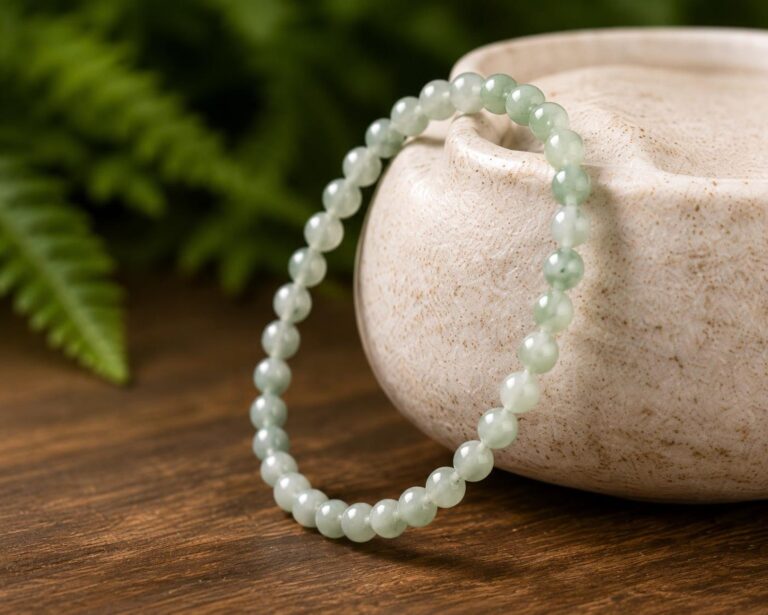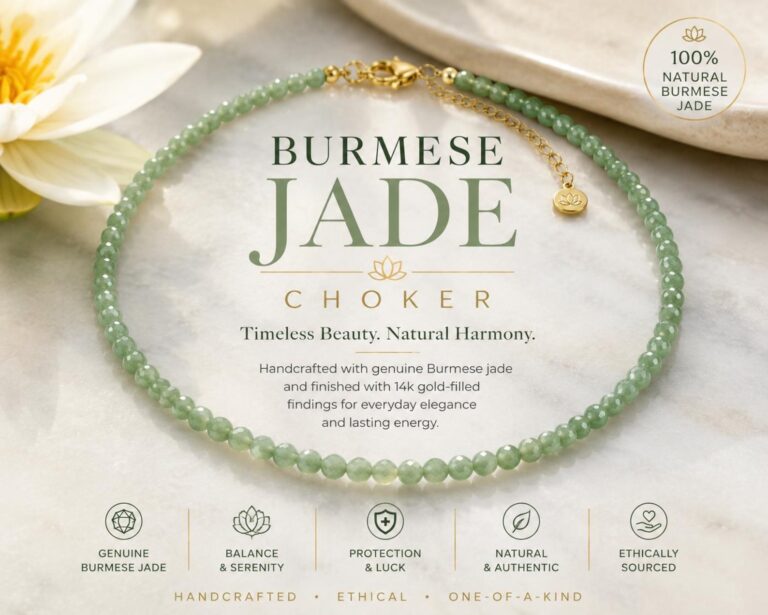
Genuine Burmese Jade Necklace – 18K Gold Filled Accents – Handmade in Canada
$199.95 CAD
Made To Order
Click to View
Few gemstones carry as much history, symbolism and mystery as jade. For thousands of years, people have carved, polished, worn and treasured jade, transforming this exceptionally tough material into jewelry, ceremonial objects, sculptures and heirlooms. Its most famous colour is green, but genuine jade can also appear white, lavender, yellow, orange, brown, grey and black.
Jade is also one of the most misunderstood names in the gemstone world. It is not simply one green mineral, and not every stone marketed with the word “jade” is actually jade. Understanding the difference between jadeite and nephrite, the importance of Myanmar or Burmese jadeite, and the meaning of terms such as Type A, B and C jade can make shopping for jade jewelry much less confusing.
The word jade has traditionally been used for two different gem materials: jadeite and nephrite. They are chemically and mineralogically different, but both consist of tightly interlocking crystals that give jade its famous toughness. Modern gemological usage can also include certain green omphacite-rich material under the jade umbrella, making precise identification particularly important for valuable pieces.
Jadeite belongs to the pyroxene mineral group, while nephrite is an amphibole material composed primarily of fine interlocking tremolite-actinolite crystals. To the casual observer they can sometimes look similar, especially when green, but their chemistry, structure, typical colours and market values can be quite different.
Jadeite is generally the rarer of the two traditional jades and is capable of producing exceptionally vivid colours and fine translucency. The finest intensely green, semitransparent jadeite can rank among the world’s most valuable gem materials. Jadeite also occurs in lavender, white, yellow, orange, grey, black, brown and many shades of green.
Nephrite tends to have somewhat softer, more muted colours and an exceptionally tough interlocking structure. It can occur in white, cream, yellowish, brown, grey, black and numerous greens. Fine nephrite has been treasured for millennia and is culturally and historically important in its own right; it should not be thought of merely as an inferior substitute for jadeite.
For a jewelry buyer, the key point is that both jadeite and nephrite can legitimately be called jade, but knowing which one you are purchasing matters. A clear product description should ideally identify the material more specifically whenever that information is known.
Jade offers a wonderful lesson in the difference between hardness and toughness. Hardness measures resistance to scratching, while toughness describes resistance to breaking and chipping. Jade is not extraordinarily hard compared with sapphire or diamond, but its microscopic interlocking crystal structure makes both jadeite and nephrite exceptionally tough.
This unusual toughness helps explain why jade was used long before it became primarily associated with jewelry. Early cultures fashioned nephrite and other jade materials into tools and ceremonial objects as well as ornaments. A material capable of surviving demanding practical use could also preserve intricate carving and polishing for generations.
Green may be jade’s signature colour, but genuine jade is much more varied. Jadeite can occur in vivid emerald-like green, apple green, pale green, lavender, white, yellow, reddish orange, grey, brown and black. Nephrite commonly appears in creamy white, pale to dark green, yellow, brown, grey and black, often with softer or more subdued colour than fine jadeite.
Colour can also be unevenly distributed. In natural jade this variation may create mottling, patches, veins or transitions from one shade to another. Skilled jade carvers have historically used such natural variations creatively, allowing a patch of colour to become part of the subject or composition rather than treating it as something that must be removed.
Imperial jade is a term associated with exceptionally fine green jadeite displaying vivid, saturated green colour together with desirable translucency and fine texture. The finest material can have an almost glowing appearance because light enters and scatters through its tightly intergrown crystals.
The term should not be treated as a casual synonym for any attractive green jade. True top-quality imperial jadeite is exceptionally valuable, and important pieces require expert gemological evaluation. Colour, transparency, texture, treatment status, size and craftsmanship all influence value.
Burmese jade generally refers to jadeite associated with Myanmar, the country historically known as Burma. Myanmar’s jadeite deposits occupy an extraordinary place in gemstone history and have been the principal source of much of the world’s finest top-grade jadeite. This is why the words Burmese jade or Burmese jadeite can carry considerable prestige.
Myanmar origin does not mean that every piece of Burmese jade is imperial quality. The deposits produce jadeite across a wide range of colours, textures and qualities. A modest jadeite bead and an extraordinary translucent imperial-green cabochon can both originate in Myanmar while differing enormously in rarity and value.
Myanmar became the historic source most strongly associated with fine jadeite entering the Chinese market. The important deposits of northern Myanmar, particularly in Kachin State, have produced exceptional jadeite for generations. Fine green material from these deposits helped transform jadeite into one of the most prestigious gemstones in Chinese jewelry and decorative art.
For modern buyers, however, “Burmese” is an origin claim, not merely a colour description. Appearance alone cannot reliably prove that an individual jadeite came from Myanmar. Geographic origin determination for important jadeite requires sophisticated gemological analysis, and responsible sellers should distinguish between documented origin and information supplied through the commercial chain.
Not reliably. Experienced gemologists may recognize features that suggest a possible origin, but colour alone cannot prove that a piece of jadeite came from Myanmar. High-quality green jadeite and jadeite-omphacite material are known from other localities, including Guatemala, and modern laboratories use advanced analytical techniques when geographic origin needs to be determined.
This distinction is particularly important when origin substantially increases the price. If a valuable piece is sold specifically because it is claimed to be Burmese jadeite, an independent report from a respected gemological laboratory is stronger evidence than a seller’s visual opinion alone.
The word untreated matters enormously in the jade market because jadeite can be subjected to processes that change its colour, apparent clarity or durability. Fine natural-colour jadeite without significant treatment is generally more desirable than material whose appearance has been substantially altered.
However, treatment terminology needs precision. Traditional surface waxing after polishing may be compatible with material described within the Type A category, while acid bleaching, polymer impregnation and dyeing place jadeite into different treatment categories. A seller should therefore avoid making an absolute untreated claim unless the available evidence supports it.
A widely used jadeite treatment classification describes material as Type A, Type B or Type C. These letters do not represent ordinary quality grades such as good, better and best. They describe treatment categories, which is a crucial distinction for anyone shopping for jadeite jewelry.
Type A jadeite refers to jadeite that is natural or has received only traditional waxing associated with finishing and polishing. Its colour and internal structure have not been altered by the acid-bleaching and polymer-impregnation process used for Type B material or by the dyeing associated with Type C.
Type B jadeite has been chemically bleached, typically using acid to remove unwanted material, and then impregnated with polymer resin. This can improve apparent transparency or appearance, but it materially changes the gem and should be disclosed.
Type C jadeite has been dyed to alter or enhance its colour. Dye can create an attractive appearance, but dyed jadeite should not be represented as naturally possessing that colour.
Combinations of treatment also exist, so buyers may encounter terminology describing jadeite that has undergone more than one process. For expensive jadeite, professional laboratory testing is the safest way to establish treatment status.
No. This is an especially important misunderstanding. Type A is a treatment classification, not a quality grade. Type A jadeite can range from modest commercial material to extraordinarily valuable imperial jade. A piece can be completely natural in colour and treatment status while still having ordinary colour, low translucency or coarse texture.
Likewise, attractive appearance alone does not prove Type A status. Treatments can make jadeite look more appealing, which is precisely why treatment identification often requires gemological testing.
No. Geographic origin and treatment status are separate questions. Jadeite mined in Myanmar can subsequently be bleached, polymer impregnated, dyed or otherwise treated. Calling something Burmese jade therefore does not automatically mean that it is untreated or Type A.
A careful description should treat these as distinct claims: what the material is, where it is believed or documented to have originated, and what is known about treatment. For a particularly valuable piece, laboratory documentation can address questions that cannot responsibly be answered from appearance alone.
Jade value can vary from relatively accessible jewelry material to exceptional pieces worth extraordinary sums. For jadeite, major quality considerations include colour, transparency, texture, size, treatment status and craftsmanship. In fine carvings, the skill and artistry of the maker can be enormously important as well.
Green is traditionally the most highly valued jadeite colour, with vivid, evenly distributed green and desirable translucency commanding particular attention. Lavender jadeite can also be highly prized. In all colours, fine texture and an attractive relationship between colour and transparency can greatly enhance beauty.
Fine jade colour should be considered in terms of hue, saturation, tone and distribution. A vivid green that appears alive in ordinary lighting is generally more desirable than dull or heavily greyed material. Evenness can add value, although beautifully patterned natural colour can also be attractive.
Jadeite ranges from opaque to semitransparent. Fine semitransparent material allows light to enter the stone, producing the luminous quality associated with exceptional jadeite. Transparency should be considered together with colour and texture rather than as an isolated characteristic.
Jade is made from interlocking crystals, and the size and arrangement of those crystals influence visual texture. Fine-grained jadeite can have a beautifully smooth, almost glowing appearance, while coarser material may look more granular.
Size can significantly influence value when quality is high. Matching is particularly important for beads, earrings and other multi-stone pieces because assembling natural jade with closely coordinated colour, texture and translucency can require considerable material selection.
Jade as a broad category is not uniformly rare. Commercial nephrite and jadeite exist in meaningful quantities, but exceptional material is another matter entirely. Fine translucent jadeite with vivid natural green colour is scarce, and large pieces combining superb colour, texture and treatment status can be extraordinarily valuable.
This is why statements such as “jade is rare” or “jade is inexpensive” are both too simplistic. The word jade encompasses an enormous range of materials and qualities. A small opaque commercial bead and an important imperial jadeite cabochon occupy completely different parts of the gemstone market.
Jade materials occur in several parts of the world. Nephrite has important sources in places including Canada, China, Russia and New Zealand, while jadeite and related jade materials are known from Myanmar, Guatemala and other localities. Different sources can produce distinctive colours, textures and cultural traditions.
Canada is particularly important in the modern nephrite trade, with British Columbia known for substantial deposits of green nephrite. This is a useful reminder that “jade” does not automatically mean Asian origin and that nephrite itself has a global geological and cultural story.
Few gemstones are as closely associated with a civilization as jade is with China. Jade objects have been made in China for thousands of years, long before jadeite from Myanmar became important there. Much of China’s ancient jade tradition centred on nephrite, which was fashioned into ritual objects, ornaments, carvings and symbols of rank and virtue.
Jade came to represent qualities such as virtue, purity, moral character and enduring value. Forms such as the circular bi disk acquired ceremonial and symbolic importance. When vivid jadeite from Myanmar entered the Chinese market much later, it joined an already ancient jade tradition rather than creating that tradition from the beginning.
Nephrite deserves its own appreciation. Because today’s most expensive jade headlines often concern jadeite, it is easy to assume nephrite is merely the less valuable version. Historically, that could hardly be further from the truth. Nephrite was treasured and worked for thousands of years in several cultures because of its toughness, smooth polish and beauty.
Fine nephrite can be creamy white, celadon-like, spinach green or richly dark green. Its beauty is often quieter than vivid imperial jadeite, emphasizing silky texture and depth rather than intense transparency and saturation.
Nephrite and related greenstone materials have profound cultural significance in Aotearoa New Zealand, where pounamu is treasured within Māori culture. Pounamu has been fashioned into tools, ornaments and meaningful objects and carries cultural significance far beyond its use as decorative stone.
When discussing culturally important jade traditions, it is worth remembering that gemstones are not merely commodities. Materials can carry identity, history, ancestry and meaning that cannot be reduced to gemological specifications or market price.
Jade has many imitators. Various green stones and manufactured materials have historically been marketed with names containing the word jade even though they are neither jadeite nor nephrite. Colour alone is therefore a poor basis for identifying jade.
Names such as “new jade,” “Korean jade,” “Mexican jade” and other commercial terms have sometimes been applied to materials that are not gemological jade. The exact material behind a trade name can vary, which is why a jewelry description should identify the actual gemstone whenever possible instead of relying on an attractive marketing name.
There are many popular home tests for jade circulating online, but they should be approached cautiously. Appearance, weight, temperature, sound or scratch tests are not reliable substitutes for gemological identification, and some informal tests can damage jewelry.
A gemologist can examine properties such as refractive index, specific gravity, microscopic structure and spectroscopic characteristics to identify jade and investigate treatments. Advanced testing may be required to distinguish closely related materials or determine geographic origin. For a valuable jade purchase, professional testing is much more meaningful than a home experiment.
Ideally, genuine jade should identify material that legitimately falls within accepted gemological jade terminology rather than glass or another stone merely resembling jade. But the phrase by itself does not tell you whether the material is jadeite or nephrite, whether jadeite has been treated, or whether a claimed geographic origin is documented.
For ordinary gemstone-bead jewelry, individual laboratory certification of every bead is usually impractical. Responsible jewelry makers rely on reputable suppliers and accurately communicate the information available to them. When a claim such as Burmese origin, Type A status or exceptional untreated quality materially increases the price, independent laboratory documentation becomes much more important.
Yes. Jadeite and other jade materials can be dyed or otherwise treated to alter their appearance. Dyed jadeite falls within the Type C treatment category in the commonly used A-B-C system. Dye can intensify green, lavender or other colours and may be difficult for an untrained buyer to recognize.
This is one reason unusually vivid colour at a surprisingly low price should be approached thoughtfully. It does not prove treatment, but colour alone is never enough to establish natural colour in jadeite.
Jadeite is approximately 6.5 to 7 on the Mohs hardness scale, while nephrite is approximately 6 to 6.5. This means both can be scratched by harder gemstones and materials. Their great strength lies not in exceptional hardness but in extraordinary toughness.
That combination makes jade wonderfully practical for many jewelry forms, including beads, pendants, cabochons and bangles. Nevertheless, fine polished surfaces can become scratched, and treated material may require additional care.
Jade’s exceptional toughness makes it well suited to regular wear, but sensible care is still worthwhile. Avoid unnecessary impact and abrasion, and remember that the other components of a piece—elastic, silk cord, pearls, clasps and metal findings—may be more vulnerable than the jade itself.
For handcrafted stretch bracelets, gently roll the bracelet over the hand rather than pulling it excessively. Removing jewelry before swimming, bathing, strenuous exercise, sleeping or household cleaning helps protect both gemstones and construction materials over the long term.
Warm water, mild soap and a soft cloth are a safe conservative choice for jade jewelry. Avoid harsh chemicals and abrasive cleaning materials. Because jade can be treated in ways that may not be obvious to the wearer, gentle cleaning is preferable when treatment status is unknown.
Always consider the entire piece. Jade combined with pearls or strung on elastic or silk cord should be cleaned according to the needs of those more delicate materials rather than according to what an untreated piece of jade alone might tolerate.
Jade and freshwater pearls make an exceptionally graceful pairing. Green jade introduces natural colour and visual weight, while pearls add soft luminosity. Pale jade can create an airy, almost botanical effect beside ivory pearls, while richer green jade provides stronger contrast.
The pairing also connects two materials with extraordinarily long histories in personal adornment. Used in a modern, delicate design, they can feel fresh rather than formal—particularly when smaller beads allow the natural colour and texture to speak without overwhelming the wearer.
Both can be beautiful. Yellow gold and gold-filled accents create warmth against green jade and can give the gemstone a rich, classic appearance. Sterling silver provides a cooler contrast that works particularly well with pale green, white, grey or lavender jade.
The jade itself should guide the choice. Warm apple greens may look wonderful with gold, while cooler greens can be striking with silver. There is no gemological rule governing the pairing; jewelry should ultimately suit the stone, the design and the person who will wear it.
Jade has accumulated an extraordinary range of meanings across different cultures and periods. It has been associated with virtue, purity, protection, harmony, prosperity, wisdom, longevity and good fortune. In Chinese cultural history especially, jade became associated with moral qualities and enduring value.
These meanings are cultural, historical and symbolic rather than scientifically measurable effects of the mineral. That distinction does not make them unimportant. Jewelry has always carried meaning beyond its physical materials, and an heirloom jade pendant may be precious because of family history or symbolism regardless of its market value.
Contemporary crystal traditions commonly associate jade with harmony, abundance, calm, good fortune and emotional balance. These are metaphysical beliefs and have not been established as medical or scientific effects.
People can enjoy gemstones for many reasons: beauty, geology, history, cultural significance, symbolism or personal ritual. At Divine by Design, we prefer to celebrate those stories while clearly distinguishing traditional beliefs from evidence-based health claims.
Jade is not one of the principal modern monthly birthstones most commonly used in North American birthstone lists, but it appears in various alternative birthstone traditions and is also associated with anniversaries. Jade is commonly recognized as a gemstone associated with the twelfth wedding anniversary.
There is no need for a calendar to justify choosing jade as a gift. Its associations with longevity, harmony, good fortune and enduring relationships make it naturally suited to birthdays, anniversaries, graduations, family gifts and other meaningful occasions.
Begin by finding out what the material actually is. Is it jadeite, nephrite or another material being sold under a jade-related trade name? If jadeite is described as Type A, untreated or Burmese, ask what information supports those claims. The more significantly a claim affects price, the more important reliable evidence becomes.
Then look at the jade itself. Do you love its colour? Is the natural variation attractive? Does it have the translucency, smoothness or rich opacity that appeals to you? Jade does not need to resemble imperial jade to be beautiful. Soft celadon green, creamy white, lavender and deep forest tones can all make wonderful jewelry.
Finally, consider the complete piece. Matching, bead quality, metal, stringing materials, clasp construction, comfort and craftsmanship all contribute to the value and enjoyment of jade jewelry. A modest natural jade bead used thoughtfully can make a more wearable and meaningful piece than a larger stone chosen simply because it sounds impressive.
Natural jade beads may differ in colour, translucency, mottling and texture. A strand can contain pale and deeper greens or subtle cloudy areas and mineral patterns. Those differences are not automatically defects; they reflect the complex mineral aggregate from which each bead was fashioned.
Perfectly uniform colour can certainly occur in carefully matched high-quality material, but uniformity should never be treated as the only definition of beauty. In handcrafted jewelry, subtle natural variation often gives a piece its character and makes each finished design slightly different from the next.
At Divine by Design Jewelry, jade appeals to us because it can be both ancient and wonderfully contemporary. Its soft greens work beautifully with freshwater pearls, while richer jade tones can stand confidently beside gold or silver accents. Small jade beads are especially lovely in delicate jewelry because they allow the gemstone’s colour and natural character to remain wearable every day.
We believe gemstone descriptions should also be as careful as the jewelry itself. When our supplier identifies material as jadeite, nephrite or Burmese jade, we can communicate that supplier information, but we do not believe in turning supplier descriptions into laboratory certainty. Where treatment status or geographic origin requires independent gemological testing to establish conclusively, we prefer to say so. Beautiful jewelry does not need exaggerated claims.
Jade is a gemstone term traditionally applied to jadeite and nephrite, two different mineral materials with exceptionally tough interlocking structures. Modern gemological usage can also include certain green omphacite-rich material under specific conditions.
No. Jadeite and nephrite are different mineral materials, although both have historically and gemologically been called jade. Their chemistry, structure, colours and market characteristics differ.
Exceptional jadeite, particularly fine translucent vivid green material, can reach extremely high values. Fine nephrite can also be valuable and historically important. Quality varies enormously within both categories.
No. Genuine jade can occur in white, cream, lavender, yellow, orange, brown, grey and black as well as many shades of green.
Imperial jade is a term associated with exceptionally fine jadeite displaying vivid saturated green colour, desirable translucency and fine texture. It should not be used casually for every bright green piece of jade.
Burmese jade generally refers to jadeite associated with Myanmar, formerly called Burma. Myanmar has historically been the principal source of much of the world’s finest top-grade jadeite.
In the gemstone trade, Burmese jade usually refers to jadeite from Myanmar. A seller should still identify the material and basis for an origin claim as clearly as possible.
No. Myanmar produces jadeite across a broad range of qualities. Origin alone does not make a piece imperial quality or exceptionally valuable.
Appearance alone cannot reliably prove geographic origin. For important jadeite, respected gemological laboratories can use advanced analytical techniques to evaluate origin.
Type A jadeite is natural jadeite or material that has received only traditional waxing associated with finishing and polishing. It has not undergone the acid bleaching and polymer impregnation associated with Type B or the dyeing associated with Type C.
No. Type A describes treatment status, not quality. Type A jadeite can range from ordinary commercial material to exceptional imperial jade.
Type B jadeite has been chemically bleached and impregnated with polymer resin to alter its appearance. This treatment should be disclosed.
Type C jadeite has been dyed to alter or enhance its colour. Dyed jadeite should not be represented as naturally possessing that colour.
No. Origin and treatment are separate issues. Jadeite mined in Myanmar can later be treated, so Burmese origin does not prove Type A status.
Untreated generally indicates that a gem has not undergone treatments used to alter its colour, clarity or structure, although traditional waxing may be accepted within Type A jadeite terminology. Important claims should be supported by appropriate evidence.
Yes. Jadeite can be dyed to enhance or alter its colour. In the commonly used treatment system, dyed jadeite is classified as Type C.
Yes. Jadeite may be chemically bleached and then polymer impregnated. This is associated with Type B jadeite and materially affects how the gem should be described.
Ideally it means the material is legitimately jade rather than glass or another imitation. The phrase alone does not identify whether it is jadeite or nephrite or disclose treatment and origin.
Yes. Canada, particularly British Columbia, is an important source of nephrite, which is genuine jade.
China has an ancient tradition of working genuine nephrite jade, but commercial names containing the word “jade” do not always identify actual jade. The specific material should be confirmed rather than relying on a geographic trade name.
Jade has been used in China for thousands of years in ritual objects, ornaments, carvings and jewelry and has been associated with virtue, purity, status and enduring value. Much ancient Chinese jade was nephrite.
Jadeite measures approximately 6.5 to 7 on the Mohs scale, while nephrite is approximately 6 to 6.5. Neither is exceptionally hard compared with sapphire, but both are exceptionally tough and resistant to breaking.
Yes. Jade can be scratched by harder materials, so fine polished jade jewelry should be stored thoughtfully.
Yes, although jadeite and nephrite are exceptionally tough. A sufficiently severe impact can still damage a piece, particularly where it is thin or already fractured.
Jade is well suited to frequent wear because of its toughness, but sensible care is still recommended. The construction and other materials in the jewelry may require greater caution than the jade itself.
It is better to remove fine jewelry before bathing or showering, especially when treatment status is unknown or the piece includes elastic, silk cord, pearls or delicate metal components.
Warm water, mild soap and a soft cloth are a safe conservative choice. Avoid harsh chemicals and abrasive cleaners, particularly when treatment status is unknown.
Yes. Green jade and luminous freshwater pearls create a soft, elegant contrast that works especially well in delicate jewelry.
Both can be beautiful. Gold adds warmth and richness, while silver creates a cooler, fresher contrast. The best choice depends on the jade colour and personal preference.
Jade has been associated with virtue, harmony, prosperity, purity, wisdom, longevity, protection and good fortune in various cultural traditions. These are symbolic associations rather than scientifically proven effects.
There is no reliable scientific evidence that wearing jade can diagnose, treat or cure medical or psychological conditions. Healing and energy claims associated with jade belong to spiritual and metaphysical traditions.
Jade appears in some alternative birthstone traditions but is not one of the principal modern monthly birthstones commonly used in North America. It is also associated with the twelfth wedding anniversary.
Home tests based on sound, temperature, scratching or appearance are not reliable substitutes for gemological identification and may damage jewelry. Professional testing is preferable for valuable pieces.
Exceptional natural-colour jadeite combining vivid colour, fine texture, translucency, desirable treatment status and size can be extremely scarce. Fine craftsmanship and documented provenance can further increase value.
Jade exists across a huge quality range. Opaque commercial material, small beads and more abundant nephrite or jadeite can be relatively accessible, while exceptional jadeite occupies an entirely different market.
Ask whether the material is jadeite or nephrite, what treatments are known, whether Type A status is being claimed, whether a geographic origin such as Myanmar is being claimed, and what independent documentation supports claims that materially affect the price.
Jade becomes more interesting the more closely you look at it. What begins as a familiar green gemstone opens into two great jade traditions, extraordinary geology, thousands of years of craftsmanship and a modern market where accurate identification matters enormously.
It can be humble or priceless, translucent or opaque, creamy white or vivid green. It can connect a wearer to Chinese history, Canadian geology, Māori cultural tradition, Burmese jadeite deposits or simply to the pleasure of a beautifully polished natural stone.
For us, jade’s greatest appeal may be its balance of strength and softness. Few gemstones feel so serene while being, quite literally, among the toughest materials ever treasured for jewelry.
Explore Divine by Design jewelry featuring Jade.
$199.95 CAD
Made To Order
Click to View