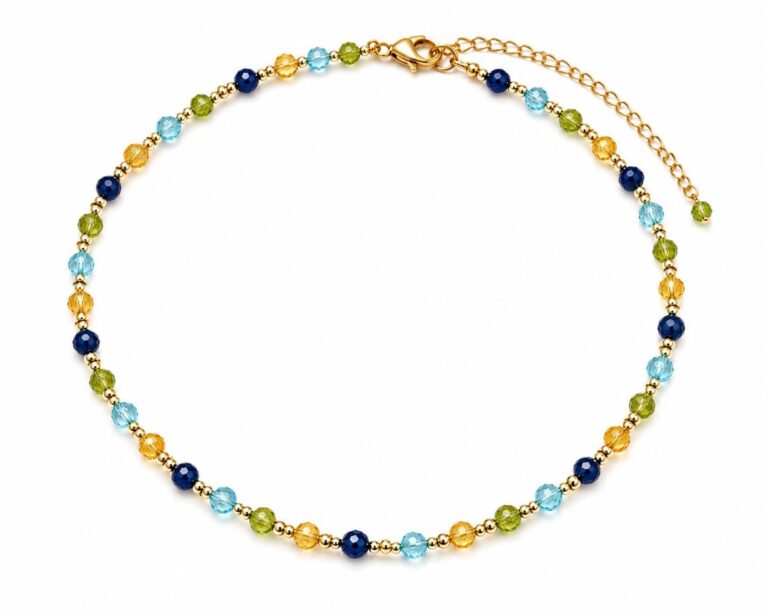
Virgo Zodiac Gemstone Choker Necklace – Citrine Peridot Blue Topaz Blue Sapphire
$199.95 CAD
Made To Order
Click to View
Fresh, luminous and unmistakably green, peridot is one of those gemstones that seems to carry its own light. Its colour can evoke everything from tender spring leaves and sunlit moss to rich olive green. Unlike many coloured gemstones, however, peridot does not need trace impurities to give it its signature hue. Green is part of the gemstone’s very nature.
Peridot also has an extraordinary story. Its history stretches back thousands of years, and some peridot crystals form deep within Earth’s mantle before being carried toward the surface by volcanic activity. Tiny crystals of its mineral family have even been discovered in meteorites. Today, peridot is treasured for its distinctive colour, beautiful transparency and cheerful personality. It is also the traditional modern birthstone for August and a wonderful choice for anyone who simply loves green gemstones.
Whether you are considering a piece of peridot jewelry, shopping for an August birthday gift, or simply curious about this fascinating stone, this guide explores what makes peridot so special.
Peridot is the transparent, gem-quality variety of olivine, a group of silicate minerals. Gem-quality peridot is primarily composed of magnesium, iron, silicon and oxygen, and its green colour is associated with iron that is naturally present within its crystal structure.
This makes peridot an idiochromatic gemstone—a gemstone whose colour comes from an essential part of its chemical composition rather than primarily from trace elements added to an otherwise colourless mineral. That distinction helps explain one of peridot’s defining characteristics: natural peridot is always green. The precise shade can vary considerably, however, ranging from pale yellow-green and fresh grassy green to olive green and deeper greens with subtle brownish undertones.
The amount and state of iron within olivine influence peridot’s colour. Some stones have a bright yellowish or lime-green appearance, while others display richer greens. Stones with excessive brown tones are generally considered less desirable in the traditional gem market than lively, saturated green specimens.
One particularly appealing feature of peridot is the way it responds to light. While certain gemstones can look dramatically different under daylight and artificial illumination, peridot tends to maintain its characteristic green appearance remarkably well. Historically, this contributed to associations between peridot and evening light. Its vivid colour can be especially beautiful beside pearls and warm-toned metals, where the fresh green provides a striking but elegant contrast.
Peridot has been found in several parts of the world, and gemstone deposits have changed in importance throughout history. Important sources have included:
One of the most historically significant sources is Zabargad Island in the Red Sea, an Egyptian island known in antiquity for producing beautiful green gemstones. Different localities can produce stones with somewhat different colour characteristics, sizes and inclusion patterns, but origin alone does not determine whether an individual peridot is beautiful or valuable. For most jewelry buyers, colour, clarity, cutting and overall visual appeal matter far more.
Part of peridot’s fascination lies in where olivine can form. Olivine is an important mineral in Earth’s upper mantle, and gem-quality material can originate at significant depths before later reaching the surface through geological processes associated with volcanic rocks. Olivine crystals can sometimes even be seen in volcanic rocks as small green grains.
This gives peridot a rather wonderful geological biography: a gemstone formed under conditions far removed from everyday life and eventually transported close enough to Earth’s surface for us to discover it. It is one reason peridot feels particularly appropriate for jewelry. Something born through immense natural processes becomes a tiny, polished object we can hold in our hands.
One of the most delightful facts about the olivine mineral family is that olivine also occurs beyond Earth. Certain rare meteorites known as pallasites contain translucent olivine crystals embedded within a metallic matrix, and some of this extraterrestrial olivine can be gem-like in appearance.
That does not mean the peridot in ordinary jewelry came from a meteorite. Almost all commercially available peridot is terrestrial. Nevertheless, the fact that olivine occurs both deep within Earth and in material from space makes its mineralogical story unusually fascinating.
Peridot has been admired for thousands of years. Green gemstones were treasured in the ancient world, although identifying historical gems can be complicated because ancient writers did not classify minerals using modern gemological methods. Stones that would today be identified as peridot were historically confused with other green gems, particularly emerald.
Egypt’s Red Sea deposits became especially famous, and peridot has long been associated with ancient Egyptian jewelry and adornment. Over the centuries, green stones appearing in religious and royal treasures were not always identified correctly. Improved gemological knowledge eventually allowed historians and gemologists to distinguish peridot from emerald and other superficially similar stones. This history is a useful reminder that gemstone names found in old documents do not necessarily correspond precisely to the minerals those names describe today.
No. Peridot and emerald can both be beautiful green gemstones, but they are entirely different minerals. Peridot is the gem-quality variety of olivine, while emerald is a green variety of the mineral beryl. Their chemistry, crystal structure, typical colour, inclusions and physical properties differ.
Emerald frequently displays bluish-green to strongly saturated green colours, whereas peridot commonly has a distinctive yellow-green, grassy-green or olive-green character. Neither gemstone is inherently “better.” They simply offer very different expressions of green. For someone who enjoys fresh, lively and slightly golden greens, peridot can be particularly appealing.
There is no single perfect peridot because beauty is ultimately personal, but several characteristics are traditionally considered when evaluating the gemstone.
Colour is one of the most important factors. Bright, attractive green stones with good saturation are generally preferred. Too much brown can reduce desirability, while very pale stones may lack the vividness many buyers associate with fine peridot. That said, a delicate yellow-green peridot can be absolutely beautiful in dainty jewelry, so the “best” colour is partly a matter of personal taste.
High-quality peridot can be quite transparent. Visible inclusions may affect value, particularly in larger faceted stones, but natural inclusions are not automatically defects. They are part of the geological story of a natural gemstone, and some peridot displays distinctive internal features that gemologists can use as clues when examining the stone.
A good cut allows light to travel through the gemstone attractively and brings out its lively colour. Peridot is available in many shapes, including rounds, ovals, cushions, pears and more elaborate faceted cuts. Small faceted peridot beads can sparkle beautifully while retaining the organic character that makes gemstone jewelry so appealing.
Fine peridot becomes less common in larger sizes, particularly when excellent colour and clarity are required. Small stones and beads, however, can provide exceptional colour and sparkle and are especially suited to delicate jewelry designs.
Yes. Natural peridot can contain inclusions. One feature traditionally associated with peridot is sometimes described as a “lily pad” inclusion. These are characteristic disk-like stress features that may appear around other inclusions. Not every peridot will show them, and their absence does not mean a stone is not genuine.
Natural gemstones are products of geological processes rather than factory production, so small variations in colour, transparency and internal characteristics are expected. In handcrafted gemstone jewelry, those subtle differences can be part of the charm. No two strands of natural gemstone beads will ever be perfectly identical.
Peridot itself is not among the world’s rarest gemstones, but exceptional peridot can certainly be uncommon. Large stones combining excellent clarity, beautiful saturated colour and skilled cutting command considerably more attention and value than abundant commercial-grade material.
As with many gemstones, statements such as “rare” need context. A small commercial peridot bead and an unusually large, beautifully coloured gem-quality specimen are technically the same gemstone, but they occupy very different parts of the market.
Peridot spans a broad price range. Small stones and beads can be relatively accessible, making genuine peridot possible in jewelry that does not carry the price of emerald, ruby or fine sapphire. Larger, exceptionally clear and richly coloured stones can be substantially more valuable.
Price can be affected by colour, clarity, size, cutting quality, documented origin where commercially significant, matching quality in pairs or strands, craftsmanship in the finished jewelry and precious-metal content. When evaluating peridot jewelry, it is useful to consider the entire piece rather than judging it solely by the cost of the loose gemstone.
Compared with many coloured gemstones, peridot is notable because treatment is not generally required to produce its natural green colour. However, consumers should still be cautious about absolute claims regarding any particular gemstone unless its treatment status has been reliably documented. If treatment status is especially important to you, ask the seller what information has been supplied by their gemstone source and whether independent laboratory documentation accompanies the stone. Transparency is preferable to extravagant claims that cannot be substantiated.
Laboratory-created materials and imitations can be sold in the jewelry marketplace, so “green gemstone” should never automatically be assumed to mean natural peridot. Glass and other materials can imitate its appearance, and a reputable seller should accurately describe what is being offered rather than presenting imitation material as natural gemstone. For especially valuable loose gems or important jewelry purchases, independent gemological testing can provide additional assurance.
Peridot measures approximately 6.5 to 7 on the Mohs scale of mineral hardness. That makes it suitable for many kinds of jewelry, but it is not as hard as sapphire or diamond. Hardness refers specifically to resistance to scratching and should not be confused with toughness or resistance to impact. Peridot deserves sensible care, particularly when worn in rings or bracelets that may encounter hard surfaces. In necklaces and earrings, where gemstones generally experience less impact, peridot can be an excellent choice for regular wear.
Yes—with reasonable care. Peridot can certainly be worn frequently, particularly in jewelry that is designed and constructed well. As with most natural gemstone jewelry, however, it is sensible to remove it before activities likely to expose it to impact, chemicals, excessive moisture or abrasion. That includes swimming, bathing, strenuous exercise and household cleaning. Bracelets should be treated particularly thoughtfully because wrists routinely encounter desks, counters, door frames and other hard surfaces without us noticing. A little care can significantly extend the life of both the gemstone and the jewelry itself.
Gentle cleaning is best. For most peridot jewelry, use lukewarm water, mild soap and a soft cloth or very soft brush when appropriate for the construction of the piece. Rinse carefully and dry thoroughly with a soft cloth, and avoid harsh household chemicals and abrasive cleaners. Because finished jewelry may contain pearls, elastic, silk cord, adhesives or other materials requiring different care from the gemstone itself, always consider the construction of the entire piece before cleaning it. When in doubt, follow the jewelry maker’s care instructions.
Peridot and freshwater pearls make a particularly lovely pairing. Pearls have a soft, luminous appearance, while peridot introduces fresh green colour and sparkle. Together they can feel romantic without becoming overly formal, and the contrast allows relatively small gemstones to have considerable visual impact.
In a delicate bracelet, tiny peridot accents among creamy freshwater pearls can suggest leaves, vines, gardens and summer fruit without requiring literal botanical shapes. This is one reason we enjoy using peridot throughout some of our Divine by Design gemstone jewelry. It works beautifully as both a featured gemstone and a supporting accent.
Both can be beautiful, and the choice can noticeably change the character of the gemstone. Yellow gold and gold-filled accents emphasize the warm yellow undertones that naturally occur in many peridots, creating a rich, sunny look. Sterling silver creates a cooler, fresher contrast and can make lively green peridot appear particularly crisp and contemporary. Add freshwater pearls to either metal and the result becomes softer and more romantic. Ultimately, there is no correct metal for peridot; choose the combination that appeals to you.
Peridot is widely recognized as the modern birthstone for August. That makes peridot jewelry a natural birthday gift for someone born during the month, but birthstones do not need to be treated as rules. Many people wear peridot simply because they love green. Birthstone jewelry can also commemorate children, grandchildren, partners and other important people, turning a beautiful piece of jewelry into something personally meaningful.
Peridot is also associated in modern anniversary-gift traditions with certain wedding anniversaries, although anniversary gemstone lists vary between sources and countries. If you are choosing anniversary jewelry, there is no need to be constrained by a chart. A gemstone connected to a wedding month, favourite colour, shared memory or meaningful place can be far more personal than following a prescribed list.
Peridot has accumulated many symbolic associations over its long history. It has variously been connected with light, protection, prosperity, renewal, happiness, friendship, harmony and abundance. These associations belong to cultural traditions, folklore and modern gemstone symbolism and should not be confused with scientifically established properties.
There is nothing wrong with enjoying gemstone symbolism—jewelry has carried symbolic meaning for thousands of years. The important distinction is between saying “peridot has traditionally been associated with…” and claiming that wearing a gemstone can medically or scientifically produce a particular outcome. At Divine by Design, we prefer the former. A gemstone can be meaningful without needing to be medicine.
In contemporary crystal traditions, peridot is sometimes described as a stone associated with positivity, abundance, emotional renewal or releasing negative patterns. These are spiritual and metaphysical beliefs rather than conclusions supported by scientific evidence. For some people, those traditions add a meaningful ritual or symbolic dimension to their jewelry; others simply appreciate peridot because it is beautiful. Both are perfectly valid reasons to enjoy a gemstone.
When shopping for peridot jewelry, begin with the piece itself rather than a list of supposedly perfect specifications. Ask whether you genuinely love the colour and whether the design suits the way you dress. Some people adore bright lime greens, while others prefer softer olive shades. A spectacular piece that remains in a jewelry box is ultimately less useful than a simple bracelet or necklace you reach for constantly.
Look for sellers who accurately distinguish genuine gemstone from simulated or laboratory-created materials and who do not make unsupported claims about origin or treatment. Remember, too, that gemstones are only one component of a finished piece. Clasps, stringing material, elastic, wire, findings and workmanship all affect durability. Thoughtful construction and clear care instructions can be just as important as the gemstone itself.
One of the joys of genuine gemstone jewelry is that the stones are not perfectly uniform. A strand of peridot beads may contain subtle differences in hue, transparency, internal characteristics and pattern, particularly in small handcrafted pieces where the gemstones can be viewed closely. Mass-produced imitation beads can be engineered to look virtually identical; natural stones generally cannot. For us, that is not something to eliminate—it is part of what makes a handcrafted gemstone piece personal.
At Divine by Design Jewelry, we create jewelry in small quantities using genuine gemstones, freshwater pearls and carefully selected findings. Peridot is one of our favourite accent gemstones because its fresh green colour works beautifully with so many other stones. You’ll find it appearing alongside luminous pearls and berry-coloured gemstones in designs inspired by gardens, fruit, flowers and the changing seasons. Because our pieces are handmade rather than mass produced, natural variations between gemstones mean each finished piece has subtle differences of its own. That individuality is part of the design.
Natural peridot is green. Its colour can range from yellow-green and lime green to grassy, olive and deeper green shades. Brownish undertones may also occur.
No. Peridot is gem-quality olivine, while emerald is a variety of beryl. They are completely different minerals despite both being green gemstones.
Yes. Natural peridot is a genuine mineral gemstone and has been used in jewelry for thousands of years.
Yes. Green is inherent to peridot’s composition, although the precise shade and saturation vary.
Peridot is the gem-quality variety of olivine.
Its green colour is associated with iron that is naturally present within the mineral’s crystal structure.
Yes. Peridot is widely recognized as a modern birthstone for August.
It can range from relatively affordable to considerably more valuable. Price depends on factors such as colour, clarity, size, cutting and overall quality.
Not automatically. Attractive saturation and a pleasing green colour are important, but stones that become excessively dark, muddy or brown may be less desirable. Overall visual appeal matters more than simply choosing the darkest stone.
Commercial-quality peridot is available in meaningful quantities, but large stones with exceptional colour and clarity are much less common.
Important sources have included Myanmar, Pakistan, China, Egypt, Arizona in the United States, Vietnam and parts of East Africa.
Some olivine originates deep within Earth and can be brought toward the surface through volcanic geological processes. Olivine can also occur visibly within volcanic rocks.
Olivine occurs in certain meteorites, including rare pallasites. This does not mean ordinary commercial peridot jewelry is made from meteorites; nearly all jewelry-grade peridot sold conventionally comes from Earth.
Peridot has a Mohs hardness of approximately 6.5 to 7, making it harder than ordinary window glass, although hardness can vary and does not mean the gemstone is immune to damage.
Yes. Despite being reasonably hard, peridot can still be scratched by harder materials and should be stored thoughtfully.
It is better to remove gemstone jewelry before showering or bathing. Soap residue, chemicals and repeated exposure to moisture may affect the entire piece, including its stringing material and metal components.
We recommend taking a conservative approach and avoiding ultrasonic cleaning unless a qualified jeweller familiar with the particular piece advises that it is appropriate. Gentle hand cleaning is safer for many pieces.
Yes, provided it is worn with reasonable care. Necklaces and earrings are generally less exposed to impact than rings and bracelets.
Store it separately or in a soft pouch so that harder gemstones and metal jewelry do not scratch it. Keeping individual pieces separated also helps prevent tangling.
That is entirely personal. Gold emphasizes peridot’s warm yellow-green qualities, while silver provides a cooler contrast. Both can be beautiful.
Yes. Creamy freshwater pearls and fresh green peridot make an especially attractive combination, balancing soft lustre with bright gemstone colour.
Peridot pairs beautifully with pearls and can also complement garnet, sapphire, ruby, aquamarine, amethyst and many other coloured gemstones depending on the design.
Absolutely. It is especially meaningful for August birthdays, but its vivid green colour also makes it a lovely gift for gardeners, nature lovers and anyone who enjoys green gemstones.
There is no reliable scientific evidence that wearing peridot can treat or cure medical or psychological conditions. Healing and energy claims associated with peridot belong to spiritual, cultural and metaphysical traditions.
Historically and in modern gemstone traditions, peridot has been associated with ideas such as light, renewal, happiness, abundance and protection. These are symbolic associations rather than scientifically established effects.
Visual appearance alone is not always sufficient to authenticate a gemstone. A trained gemologist can use specialized testing to distinguish natural peridot from imitations and other green materials. For significant purchases, independent laboratory documentation provides greater assurance than appearance alone.
There are gemstones that occur in almost every colour imaginable. Peridot is different. Green is not merely one of its possibilities; it is fundamental to what the gemstone is.
Perhaps that is why peridot has such a distinctive personality. Its colour can be delicate or vivid, sophisticated or playful, but it almost always feels alive. Add its extraordinary geological origins, thousands of years of human history, status as August’s birthstone and ability to pair beautifully with pearls and other gemstones, and it becomes easy to understand why peridot has remained treasured for so long.
For us, its appeal is simpler still: peridot brings a little flash of fresh green life to jewelry—and sometimes that is reason enough to fall in love with a gemstone.
Explore Divine by Design jewelry featuring Peridot.
$199.95 CAD
Made To Order
Click to View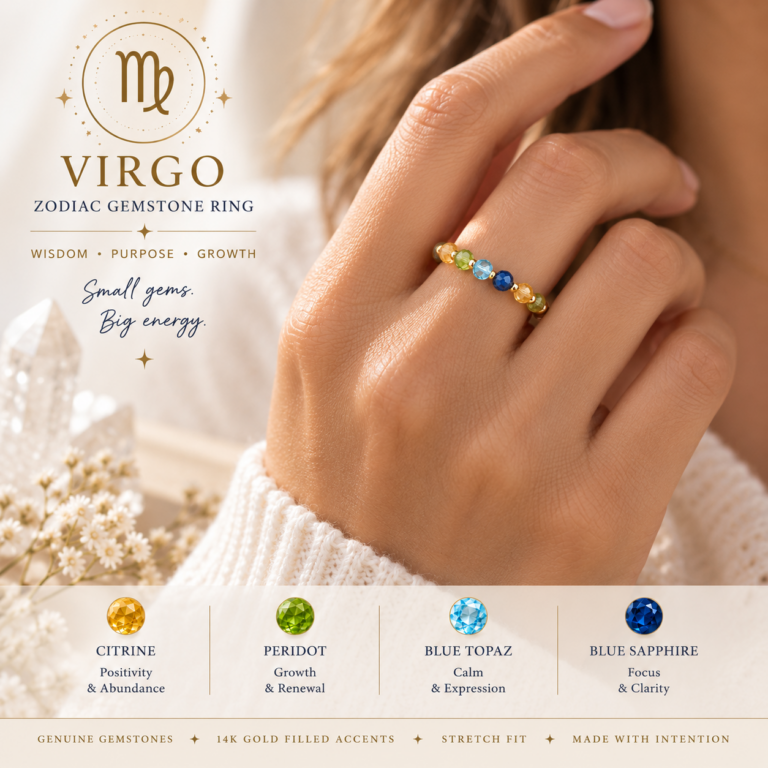
$69.95 CAD
Made To Order
Click to View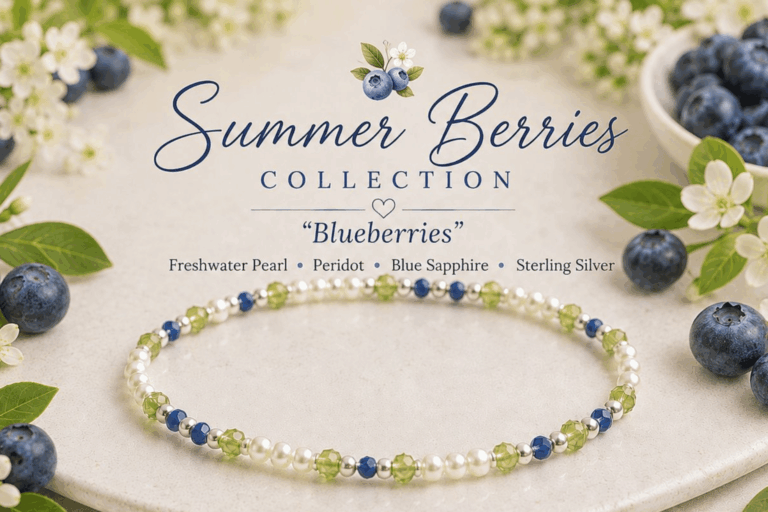
$149.95 CAD
Low Stock
Click to View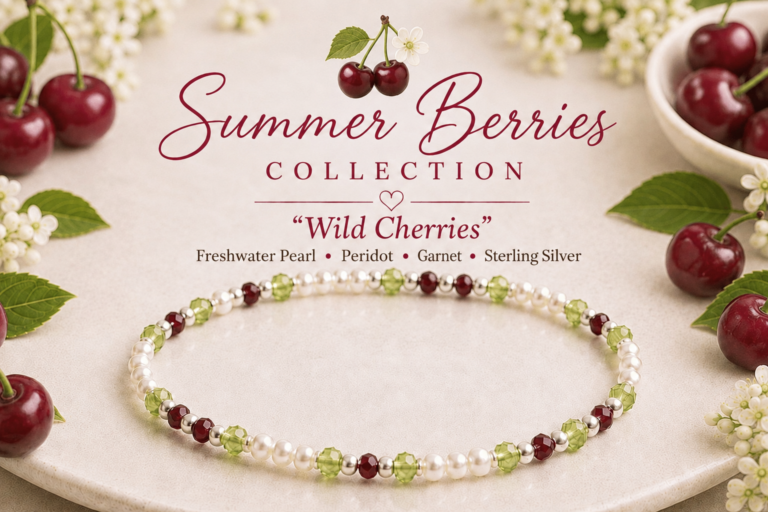
$149.95 CAD
Low Stock
Click to View