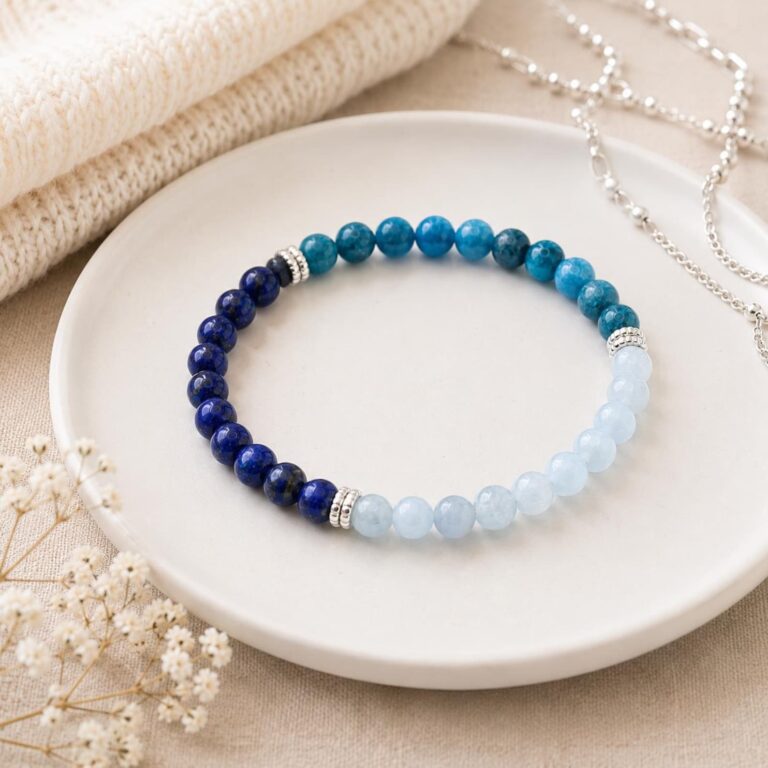
Weight Loss Bracelet for Women with 3AAA Apatite Aquamarine & Lapis Lazuli
$129.95 CAD
Made To Order
Click to View

Blue apatite can look like a piece of clear tropical water caught in stone. Its vivid color is the kind that makes a simple bead or pendant do all the talking.
Blue apatite is a genuine gemstone prized for shades that range from airy sky blue to deep teal-blue and bright, almost electric blue. It brings lively color to handmade jewelry without feeling overly formal, making it a compelling choice for necklaces, bracelets, earrings, anklets, and custom designs. This guide explains what blue apatite is, how to shop for it, how to care for it, and what its symbolism means in context.
Apatite is a mineral group made primarily of calcium phosphate. Gem-quality apatite occurs in a wide range of colors, including green, yellow, violet, colorless, and blue. Blue apatite is the name used for the blue varieties cut into beads, cabochons, faceted stones, and other jewelry components.
Its mineral chemistry is commonly expressed as Ca5(PO4)3(F,Cl,OH). That formula represents a family of closely related minerals rather than one perfectly uniform material. Small differences in chemistry and crystal structure, along with trace elements, can influence an apatite’s color. In practical terms, each stone can show its own mix of blue, greenish-blue, saturation, translucency, and internal character.
On the Mohs scale of hardness, apatite measures 5. For perspective, quartz measures 7 and diamond measures 10. Blue apatite is therefore beautiful in jewelry, but it deserves more thoughtful wear and storage than harder gems such as sapphire, spinel, or topaz.
The appeal of blue apatite is not merely that it is blue; it is the particular personality of the blue. Some stones are soft and watery, while others have a saturated blue-green glow that can read as neon in the right light. Transparent material may be faceted for lively flashes, while translucent or included material can be especially lovely as smooth beads or cabochons.
Color in apatite can vary considerably from stone to stone. A strand may include subtle shifts from aqua to teal, and a handcrafted design may deliberately celebrate that variation rather than hide it. Natural inclusions, tiny internal features, and uneven color can be part of a stone’s identity. They should not automatically be treated as flaws, although clarity, cut, durability, and overall finish all matter when choosing jewelry.
“Neon apatite” is a descriptive trade term, not a separate mineral species or a standardized quality grade. It is often used for especially bright, highly saturated blue-to-blue-green apatite, including material associated with Madagascar. Two sellers may use the word differently, so judge the individual stone by its actual color, brightness, transparency, cut or bead quality, and condition rather than by the label alone.
Apatite is found in many parts of the world. Gem-quality blue apatite has been produced from localities including Madagascar, Brazil, Mexico, Myanmar, and Sri Lanka, among others. Availability, color, and crystal habit can change as deposits and production change.
A country name can be informative, but it is not a guarantee of quality. A beautifully cut, well-matched blue apatite from one source is not inherently less appealing than material from another. Unless a seller specifically documents origin for a particular stone, it is best not to assume a precise mine or country of origin from color alone.
Blue apatite jewelry is often chosen for color first—and rightly so—but a few practical details make a meaningful difference. Look for a hue that you genuinely enjoy wearing, a design suited to the stone’s moderate hardness, and workmanship that protects the gem from unnecessary knocks.
It can be, particularly in a protective setting and for someone willing to remove jewelry during hands-on activities. Still, blue apatite is usually a more carefree choice for earrings and necklaces than for an everyday ring. Bracelets and anklets can be lovely, but they are more exposed to bumps against desks, door frames, countertops, and other hard surfaces. If you love blue apatite’s color, choosing the right jewelry style is a smart way to enjoy it often while treating it kindly.
Gemstones may be cut, polished, drilled, assembled into jewelry, or undergo treatments intended to improve or alter appearance. Treatment practices can vary by material and supplier, so it is not responsible to assume that every blue apatite is untreated—or that a blue color alone proves treatment.
When treatment status is important to your purchase, ask the seller direct questions: Is the stone represented as natural? Has it been disclosed as heated, dyed, coated, fracture-filled, or otherwise treated? Is the claim based on supplier information, laboratory testing, or visual assessment? Clear disclosure helps you compare pieces fairly and care for them appropriately.
It is also worth remembering that “natural” does not mean identical. Natural blue apatite can vary widely in hue and clarity, and a naturally occurring gemstone may still have been cut and polished for jewelry, as it should be.
Blue apatite’s Mohs hardness of 5 means it can be scratched by many common jewelry stones, including quartz. It is also relatively brittle compared with tougher gems, so avoiding impacts is just as important as avoiding abrasion.
If a piece is strung, wire-wrapped, or contains additional materials, care needs can depend on the entire design—not only the apatite. When in doubt, gentle cleaning and careful storage are the safest approach.
Blue has long been associated in many cultures with water, sky, calm, insight, and communication. Modern crystal and metaphysical traditions often connect blue apatite with clarity, self-expression, learning, motivation, and the throat chakra. These are spiritual or personal-belief associations, not scientifically established effects or medical claims.
There is no need to subscribe to a particular tradition to enjoy the stone. For some people, blue apatite simply represents a favorite coastline, a memorable trip, a calm color palette, or a desire to wear something bright and uncommon. Personal meaning is allowed to be personal.
Blue apatite occupies an interesting place among blue gemstones. It can offer a vivid, fresh color at a different price and durability point than famous blue gems, but it should not be treated as a substitute in every situation.
Visual similarity is not reliable identification. If identifying an individual stone matters—for insurance, resale, or a significant purchase—a qualified gemologist can examine it using appropriate gemological methods.
The best blue apatite jewelry is not necessarily the darkest, clearest, or most dramatic piece. It is the piece whose color makes you pause, whose proportions feel good when worn, and whose design fits your real life. A small pair of blue apatite earrings can add a clear shot of color to everyday outfits. A necklace can make the stone a focal point. A bracelet can feel intimate and easy to glance at—provided it is reserved for gentler moments.
Consider the colors already in your wardrobe. Blue apatite can look crisp with white, silver, gray, navy, and denim; it can also create a memorable contrast with warm neutrals, coral, peach, and gold-toned accents. Because the material can range from blue to blue-green, each piece may lean slightly cooler or warmer. That is not inconsistency. That is the pleasure of a natural gem with a little weather of its own.
Yes. Blue apatite is a genuine gemstone variety within the apatite mineral group. It is composed primarily of calcium phosphate and is used in beads, cabochons, faceted stones, pendants, earrings, bracelets, and other jewelry.
Blue apatite measures 5 on the Mohs hardness scale. It is softer than quartz, which means it can scratch from contact with dust, sand, countertops, and harder jewelry. It should also be protected from hard impacts because it can chip or fracture.
You can wear it regularly if you are mindful, but it is not an ideal carefree, all-activity gemstone. Earrings and necklaces are generally lower-risk choices than rings, bracelets, and anklets. Remove blue apatite before exercise, chores, sports, swimming, showering, and any activity likely to cause knocks or chemical exposure.
Blue apatite can be used in a ring, especially with a protective setting and occasional wear, but its hardness and brittleness make it less practical than sapphire, spinel, or diamond for an everyday ring. A pendant, necklace, or earrings are often better choices for frequent wear.
Blue apatite can range from pale sky blue and aqua through teal-blue to intense, vivid blue-green. Individual stones may show uneven color, lighter zones, darker areas, or a blend of blue and green. This natural variation is common.
No. “Neon apatite” is a trade description for unusually vivid blue or blue-green apatite, not a distinct mineral species. It is not a standardized grade, so assess the individual piece rather than relying on the word “neon” alone.
Gem-quality blue apatite has been found in several countries, including Madagascar, Brazil, Mexico, Myanmar, and Sri Lanka. Specific production and availability change over time, and origin should not be assumed unless it is documented for the individual stone.
Treatment status should be disclosed for the individual gemstone when known. Do not assume that every blue apatite is untreated, or that a particular blue color proves a treatment occurred. Ask the seller whether any treatment has been disclosed and what information supports that disclosure.
Use lukewarm water, mild soap if needed, and a soft cloth or very soft brush. Dry the piece carefully. Avoid ultrasonic and steam cleaners, harsh chemicals, bleach, acids, and strong heat. Store it separately from harder gemstones and metal pieces that could scratch it.
A brief gentle cleaning with water is generally preferable to harsh cleaning methods, but blue apatite jewelry should not be soaked, worn while swimming, or exposed to hot water and pool or ocean chemicals. The jewelry’s stringing, wire, clasps, and other components may also have their own care limitations.
Blue apatite is associated in modern crystal traditions with communication, clarity, focus, and the throat chakra. Those associations are matters of spiritual belief and personal practice, not proven medical or scientific effects. Gemstones should not replace professional medical care, mental health support, or evidence-based treatment.
Blue apatite is not one of the standard modern or traditional monthly birthstones. It can still be a thoughtful personal gift for anyone drawn to its color, symbolism, or connection to a special memory.
Color alone cannot reliably identify blue apatite because several gems, minerals, glass, and synthetic materials can look similar. A qualified gemologist can use properties such as refractive index, magnification, spectroscopy, and other tests to identify a stone. For an important purchase, request clear and accurate gemstone information from the seller.
Explore Divine by Design jewelry featuring Blue Apatite Gemstones & Jewelry Guide.
$129.95 CAD
Made To Order
Click to View