
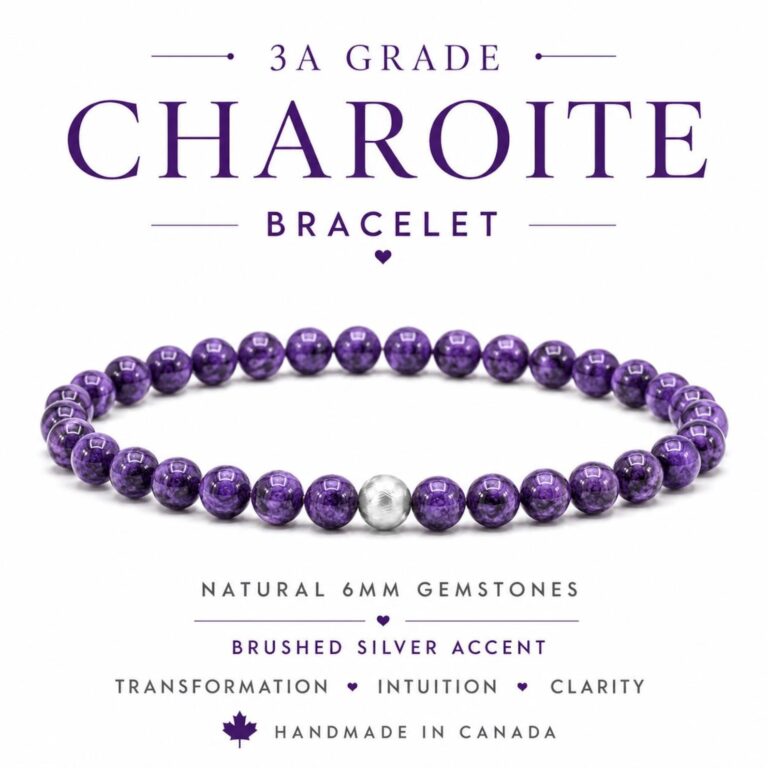

Charoite Gemstones & Jewelry Guide
Charoite: A Rare Purple Gemstone with a Wild, Woven Heart
Charoite does not do subtle. Its violet currents, smoky swirls, and pearly flashes look as though a landscape has been folded into stone.
Charoite is one of the jewelry world’s most distinctive purple gemstones: rare, richly patterned, and closely tied to a remote region of Siberia. Unlike transparent violet gems such as amethyst, charoite is usually admired for its opaque to translucent surface and dramatic, fibrous-looking patterns. It makes a memorable choice for anyone drawn to genuine gemstones with character rather than uniformity.
What Is Charoite?
Charoite is a rare silicate mineral prized as a decorative and lapidary gemstone. It is typically cut as cabochons, beads, pendants, and other smooth forms that showcase its elaborate internal patterning. Fine material may show a vivid purple body color with lavender, lilac, white, gray, black, or brown areas woven through it.
Its name is generally linked to the Chara River region of Siberia, Russia. The name is especially fitting: charoite has the visual energy of moving water, with feathery fibers and rolling bands that seem to flow beneath a polished surface.
Although it is often grouped with purple gemstones in jewelry searches, charoite is mineralogically and visually its own thing. Its appeal is not crystal clarity or faceted sparkle. It is pattern, color, and presence.
Why Charoite Is So Rare
Gem-quality charoite is associated primarily with the Murun Massif in the Sakha Republic of Siberia, Russia. This highly localized origin is a major reason the stone is scarce in the global gem market. It formed under unusual geological conditions involving complex rock alteration, and comparable commercial deposits have not become a standard part of the jewelry trade.
That limited geographic association matters to collectors and jewelry lovers alike. A charoite gemstone is not simply “another purple stone”; it represents a remarkably specific geological occurrence. Availability can vary, and attractive material with strong color, appealing pattern, and a clean polish is especially desirable.
Charoite Color and Pattern: What to Look For
Charoite’s purple color is commonly associated with trace manganese in the mineral. The finest-looking stones often display saturated violet to royal purple areas, though softer lavender and lilac tones are also beautiful and characteristic. Most charoite includes visual companions: white feldspar-like material, dark mineral inclusions, gray veining, or warm brown matrix can all appear within the stone.
The famous swirling appearance
Charoite frequently has an interlocking, fibrous or radiating structure. When cut well, those structures create its signature swirling, streaked, or feathered appearance. Some pieces look almost painterly; others resemble satin fabric, storm clouds, or violet flames. No two stones arrange these features in exactly the same way.
That variation is a strength, not a flaw. In charoite jewelry, pattern is part of the design. A stone with a broad violet field may feel bold and modern, while one with lively white and black contrast can feel graphic and wonderfully individual.
Color, polish, and composition all affect value
There is no single “best” charoite look, but buyers commonly consider the intensity and distribution of purple, the attractiveness of the pattern, the degree of distracting fractures or pits, the quality of the polish, and the overall cut. A well-shaped cabochon with an even, lustrous finish often shows charoite at its best.
Do not assume a more uniform stone is automatically superior. In a material known for expressive movement, a thoughtfully chosen pattern can be every bit as compelling as uninterrupted color.
How Charoite Is Cut for Jewelry
Because charoite is usually opaque or only slightly translucent, faceting is uncommon. Lapidaries generally use cabochon cuts, freeform shapes, ovals, teardrops, rounds, and beads. These forms preserve the stone’s color and let light travel across its polished pattern instead of asking it to sparkle like a transparent gem.
Charoite can be particularly striking in a pendant or necklace, where a larger center stone gives its markings room to speak. Bead bracelets, earrings, chokers, and anklets can also highlight the stone’s purple color in different ways, especially when a design considers comfort, scale, and protection from hard knocks.
Is Charoite Durable Enough for Jewelry?
Charoite is generally reported at about 5 to 6 on the Mohs hardness scale. That makes it softer than quartz, topaz, sapphire, and diamond, so it deserves more care than a hard everyday gemstone. Hardness describes resistance to scratching; it is not the whole story. A stone can also chip or fracture when struck, particularly at exposed edges.
Charoite is well suited to jewelry when its use matches its durability. Pendants, necklaces, earrings, and occasion-worn pieces are especially natural choices. Rings can be enjoyed too, but a protective setting, sensible wear habits, and removing the ring for hands-on work are wise. Bracelet and anklet designs should take into account that these pieces may encounter desks, door frames, countertops, and other hard surfaces.
Settings that help protect charoite
A bezel or another setting that gives the stone edge protection can be a practical choice, particularly for rings and bracelets. Smooth cabochon profiles are also less likely to catch than sharp corners. This does not make charoite indestructible, but thoughtful design helps a beautiful stone stay beautiful.
How to Care for Charoite Jewelry
Gentle care is the right approach for charoite. Clean it with a soft, damp cloth or, when needed, lukewarm water with a small amount of mild soap. Rinse carefully, dry thoroughly with a soft cloth, and avoid soaking it for long periods.
- Do not use ultrasonic or steam cleaners unless a qualified jewelry professional who has inspected the specific piece says it is appropriate.
- Avoid harsh household cleaners, bleach, abrasive powders, and strong chemicals.
- Remove charoite jewelry before sports, gardening, heavy lifting, cleaning, swimming, or work that could knock or scratch it.
- Put jewelry on after perfume, hairspray, sunscreen, and cosmetics have dried.
- Store charoite separately or in a soft pouch so harder gems and metal edges do not rub against it.
As with many colored gemstones, it is sensible to avoid prolonged exposure to intense heat and strong direct light. If your charoite jewelry has a setting with other materials, follow the care needs of the most delicate component.
Charoite Treatments and Buying Considerations
Charoite is commonly encountered as a natural, cut-and-polished gemstone, and polishing is the normal finishing process for a stone used in jewelry. Still, treatments, repairs, assembled materials, imitations, and misleading labels are realities across the broader gem market. A seller should accurately describe what a piece is and disclose relevant treatments or material construction when known.
When shopping for charoite, ask useful, direct questions: Is the stone represented as natural charoite? Has it been dyed, stabilized, repaired, or otherwise treated? Is the jewelry description clear about the materials used? Reputable sellers should welcome reasonable questions rather than hide behind vague language.
Charoite look-alikes
Several purple materials can be confused with charoite in photographs or casual browsing. Sugilite, purple fluorite, lepidolite-bearing rock, dyed agate, resin, and composites may offer purple color, but they do not share charoite’s exact mineral identity and characteristic fibrous swirl. Price alone cannot confirm authenticity; clear descriptions, close photographs, and a knowledgeable seller are more useful signals.
Charoite Meaning and Symbolism: Tradition, Not Science
In modern crystal and metaphysical traditions, charoite is often associated with transformation, courage, intuition, and calm during change. Purple has long carried symbolic associations with imagination, reflection, spirituality, and royalty in many cultural settings, which helps explain why charoite inspires such language.
These are personal, cultural, or spiritual interpretations—not established scientific or medical facts. Charoite should not be presented as a treatment for physical or mental health conditions. Its most dependable effect may be simpler and just as meaningful: a beautiful object can become a small visual reminder of an intention, a memory, or a person’s own sense of style.
Charoite as a Gift and Personal Jewelry Stone
Charoite makes an excellent gift for the person who loves unusual gemstones, purple jewelry, geological stories, or one-of-a-kind natural patterns. It is not an official modern birthstone, which can be an advantage: it feels personal rather than prescribed. A charoite necklace can mark a new chapter, a meaningful trip, an October-adjacent purple color preference, or simply a favorite shade that deserves better than ordinary.
For everyday styling, charoite pairs easily with black, charcoal, ivory, denim, cool gray, deep green, and silver-toned accents. It can also look unexpectedly rich beside warm gold tones. Since each stone varies, let the individual cabochon guide the design rather than forcing it to match a rigid color formula.
Choosing Charoite Jewelry You Will Love Wearing
Start with the stone’s pattern. Do you prefer a concentrated violet field, delicate lavender fibers, high-contrast black-and-white movement, or a blend that feels like a miniature landscape? Then consider where and how often you will wear it. A larger pendant offers visual drama, while earrings or a bracelet may provide a smaller daily flash of color.
Also look closely at scale and finish. A generous charoite cabochon can be spectacular, but a smaller stone may be the more versatile choice. The right piece is not necessarily the darkest, largest, or most uniform—it is the one whose pattern keeps catching your eye and whose design fits your life.
Frequently Asked Questions About Charoite
What is charoite?
Charoite is a rare purple silicate mineral used as a gemstone. It is best known for its swirling, fibrous-looking patterns and is usually fashioned into polished cabochons, beads, and freeform jewelry stones.
Where does charoite come from?
Commercial gem-quality charoite is strongly associated with the Murun Massif near the Chara River in the Sakha Republic of Siberia, Russia. Its limited, highly localized source is central to its rarity.
Why is charoite purple?
Charoite’s purple to violet color is generally linked to trace manganese in the mineral. Natural stones can range from pale lilac to deep violet and may include white, gray, black, or brown areas from associated minerals.
Is charoite a natural gemstone?
Yes. Charoite is a naturally occurring mineral that is cut and polished for jewelry. As with any gem purchase, read the seller’s description and ask about treatments, repairs, or material construction if those details are important to you.
Is charoite rare?
Yes. Charoite is considered rare because significant gem material is tied primarily to one remote Siberian geological area. Its limited source and distinctive appearance make it especially interesting to collectors and lovers of unusual colored stones.
Is charoite suitable for an engagement ring or everyday ring?
It can be used in a ring, but it is not as scratch-resistant as traditional everyday ring gems such as sapphire or diamond. A protective setting and careful wear are important. For frequent, low-risk wear, a charoite pendant, necklace, or earrings may be a more forgiving choice.
Can charoite go in water?
A brief, gentle wash with lukewarm water and mild soap is generally the safest at-home cleaning method. Avoid prolonged soaking, swimming pools, hot tubs, harsh chemicals, and mechanical cleaning methods such as ultrasonic or steam cleaning.
Can I wear charoite jewelry every day?
You can wear charoite regularly if you treat it thoughtfully. Remove it before activities that expose it to abrasion, impact, chemicals, or water. Necklaces and earrings are usually easier to wear often than rings, bracelets, or anklets because they receive fewer knocks.
How can I tell charoite from sugilite or dyed purple stone?
Charoite often shows distinctive feathery, radiating, or swirling structures rather than a flat, even purple color. Visual inspection alone is not always conclusive, especially online. Buy from a seller who identifies the material clearly and can answer questions about authenticity and treatments.
Does charoite have healing properties?
Some crystal traditions assign charoite spiritual meanings related to change, courage, or intuition. Those beliefs are not scientifically established health claims, and charoite should not replace professional medical or mental health care.
Is charoite an official birthstone?
No. Charoite is not an official modern birthstone. It is still a thoughtful choice for someone who loves purple gemstones, rare mineral specimens, or jewelry with a personal story.
Featured Charoite Gemstones & Jewelry Guide Jewelry
Explore Divine by Design jewelry featuring Charoite Gemstones & Jewelry Guide.